Myanmar’s urban assassins
Al Jazeera’s Investigative Unit exposes military attempts to crush underground rebel groups operating in big cities.

“From the moment I was arrested, I considered myself a dead man,” Arkar said.
The electrician from central Myanmar was part of an underground assassin squad that targeted security personnel and infrastructure tied to the military government in their city strongholds. Once detained, he knew his military captors would show little mercy.
“Arkar”, who asked to use a pseudonym to protect his identity, said he endured weeks of torture in secret detention centres before being sentenced to three years at Insein Prison, Myanmar’s most notorious jail.
But unlike many captured urban guerrillas, Arkar survived.
Al Jazeera’s Investigative Unit has analysed leaked military documents, secret recordings and rare insider testimonies to expose how military leaders are struggling to defend Myanmar’s largest cities from urban rebel groups, revealing the fighter forces, extrajudicial killings, and torture centres at the front lines of the country’s civil war.
Becoming a rebel
Arkar, 32, was part of a secret wing of Myanmar’s resistance movement, which targets people associated with the military coup that overthrew the democratically elected government on February 1, 2021.
He made sound bombs and other remote-controlled explosives for the squad - some designed to cause disruption, others to damage infrastructure and even kill - and told Al Jazeera that at times he had also pressed the detonator button.
WATCH: Arkar describes carrying out attacks.
As a trained electrician, Arkar had been making a comfortable living when Myanmar’s security forces opened fire on thousands of peaceful protesters of the coup in late February 2021.
That event marked the start of widespread military violence against civilians. Angered by the killings, Arkar decided the time for peaceful protest was over.
In May 2021, he started two months of gruelling training with an established ethnic army in rural Myanmar. Rebel groups like the one Arkar trained with have been fighting for decades for minority rights in the country.
Arkar and some fellow trainees decided the military could not be defeated by conventional warfare alone. The battle-hardened resistance forces he trained with had tactical advantages in the jungles and hilly terrain, but they lacked the firepower to threaten generals in their city strongholds.
After reaching out to discuss alternatives with friends in the resistance movement, Arkar joined a secretive urban fighter network in Myanmar’s largest city, Yangon, where he used his skills as an electrician to help create explosives. He estimated that between September 2021 and February 2022, he was involved in about 50 attacks.
The military government’s grip
Civil war erupted after the coup, and in the years since, the military regime has suffered a series of significant defeats in rural areas to established ethnic armies and civilian groups fighting together as resistance forces.
While both sides claim dominance on the battlefield in Myanmar’s frontier regions, the ruling generals have maintained control over all of the major cities, where two-thirds of the population resides.
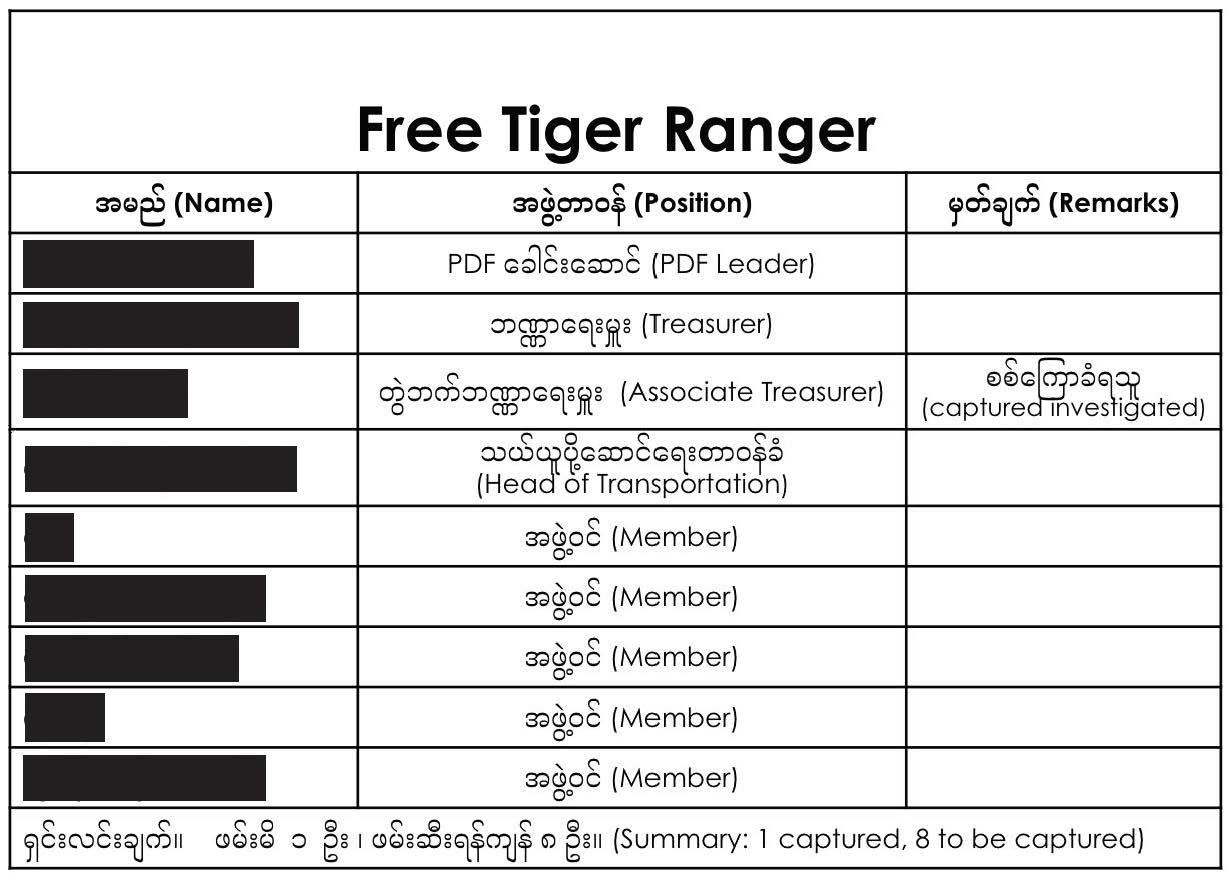
In the wake of the coup, dozens of urban fighter groups took root in cities across Myanmar. Internal military presentations leaked to Al Jazeera reveal growing alarm over the threat they pose, identifying specific groups and their leadership that concern the military.


To win the war, resistance leaders have told Al Jazeera that they must wrest Yangon, the capital Naypyidaw, and Mandalay, Myanmar’s second-largest city, from the military, and that urban fighter forces will be key to that effort.
Leaked military files reveal that capturing city-based fighters is a priority for the military government. Documents include the names of hundreds of people allegedly connected to these groups and reports about those who have already been arrested.



The urban fighter group threat
The military government has good reason to fear urban assassins. They have targeted and assassinated military officials, a retired general, regime supporters, and allied businesspeople in cities like Yangon since 2021.
For example, on May 22, 2025, a little-known group called the Golden Valley Warriors gunned down retired Brigadier General Cho Tun Aung as he was distributing alms to Buddhist monks outside his Yangon home. The rebels justified his murder by saying the former diplomat continued to serve the military regime as a lecturer at a training college for soldiers.
When a six-year-old girl was among the 16 people arrested in connection with Cho Tun Aung’s murder, the incident made international headlines and showed how even children have been caught up in the crackdown on urban fighters.
Cho Tun Aung was a high-profile victim, but attacks on civilians associated with the military government rarely make the news outside Myanmar. Yet, data from the independent monitor Armed Conflict Location and Event Data Project ranks Myanmar as having the world’s second-highest rate of attacks targeting local officials after Mexico.
Targeting civilians is banned under the Geneva Conventions and may constitute a war crime. The latest figures from the United Nations show that at least 169 government administrators, their family members, religious figures, and other civilians aligned with the military government have been killed in politically motivated murders across Myanmar over the past four and a half years. These figures, based only on verified death tolls, are conservative, and the real number could be much higher.


The rebels’ targets are often lower-ranking district bureaucrats whose administrative roles support the military government in its surveillance and arrest of alleged dissidents.
Among their first high-profile civilian victims was Lily Naing Kyaw, who was shot in Yangon in 2023. The celebrity singer, known for her support of the military government, succumbed to her injuries a week later.
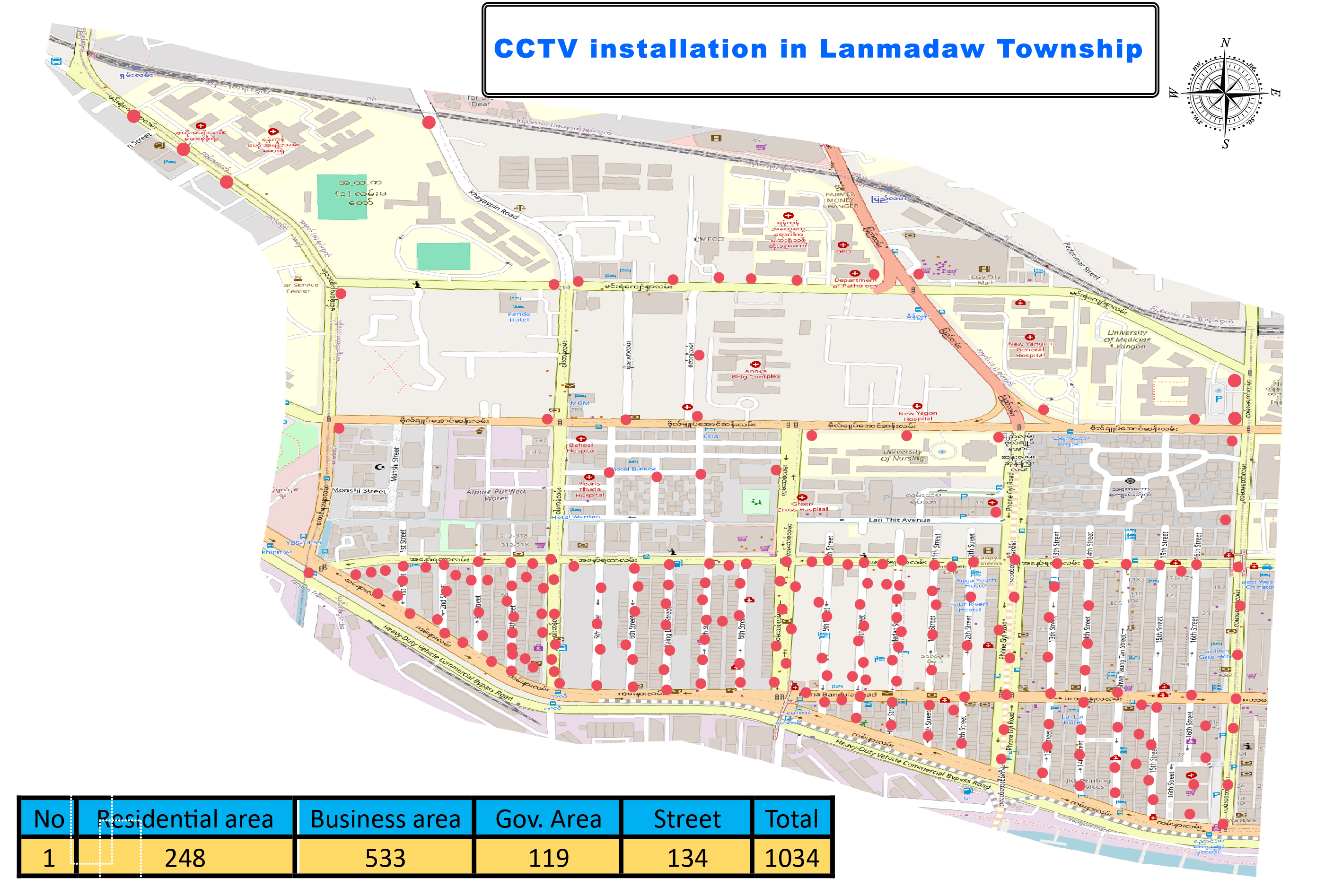
The extent of the urban assassin threat is revealed in military slideshows leaked exclusively to Al Jazeera, which document the effect of guerrilla attacks and assassinations in parts of Yangon.


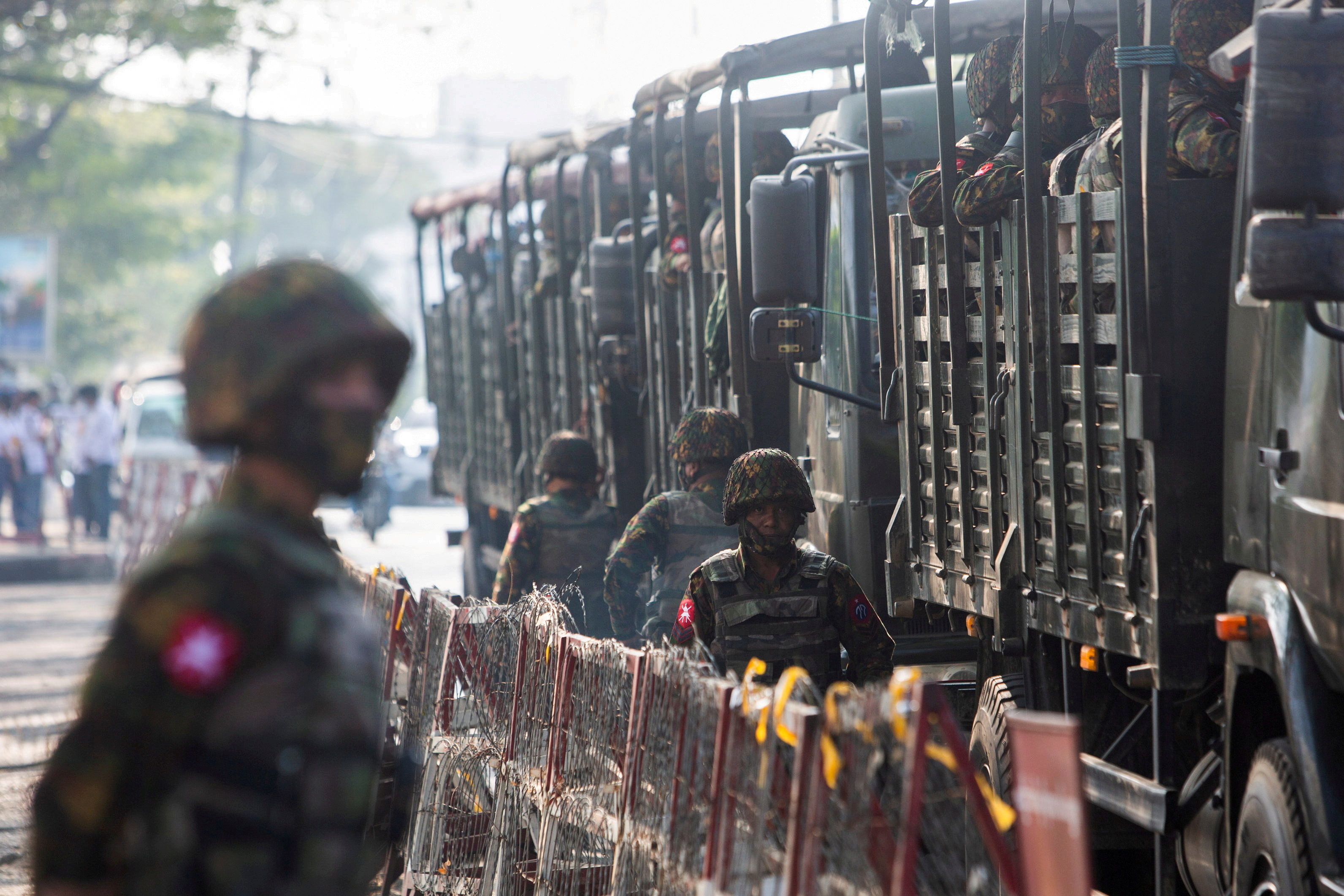
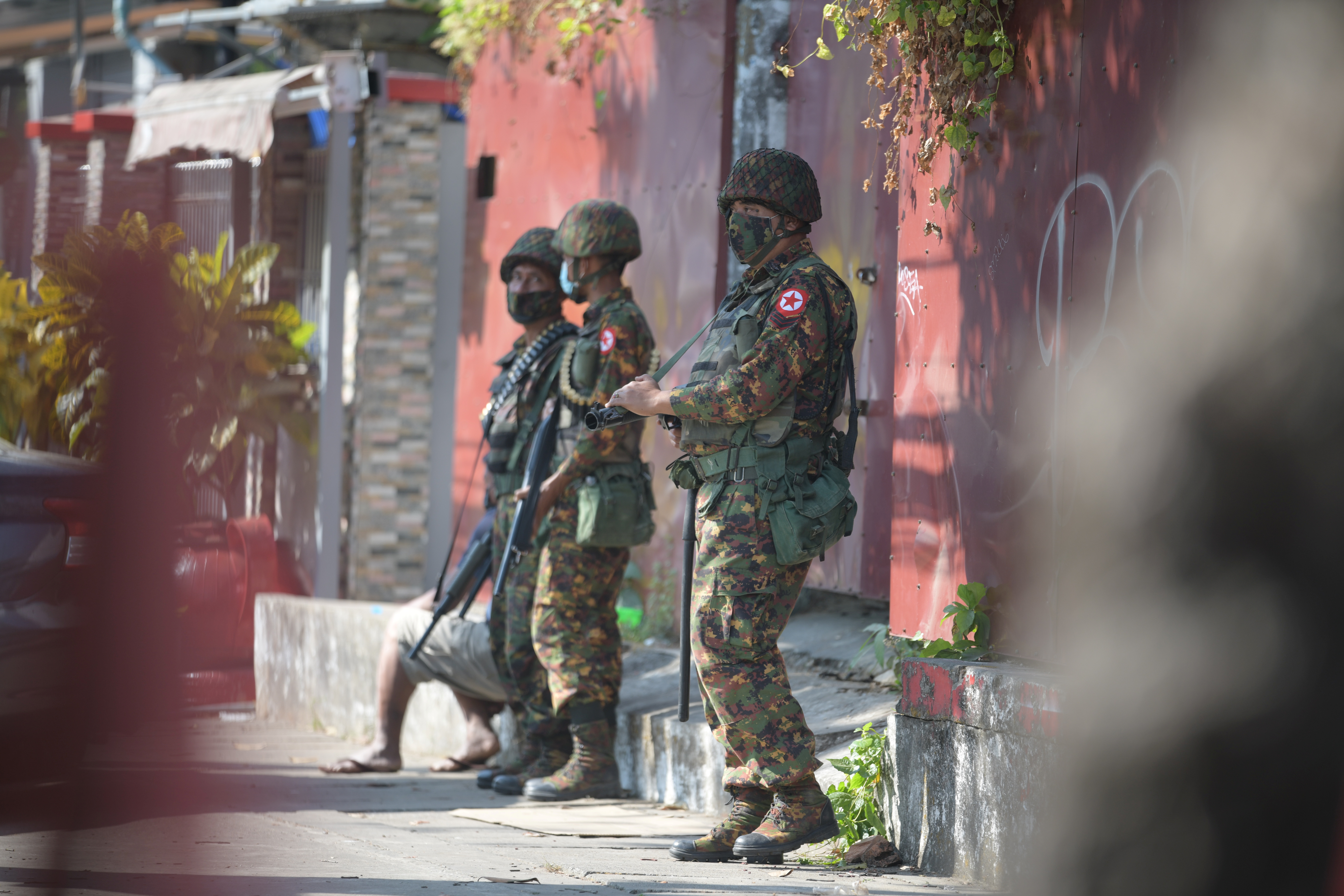
In response to targeted urban attacks, the military government has ramped up surveillance, checkpoints and patrols, and it has deployed armed guards at strategic points across Myanmar’s cities.


The military government’s efforts to purge its cities of urban fighter groups have also led to widespread arrests of citizens. Leaked files reveal civilians are targeted during random checks on public transport and apartments. Some citizens have been apprehended for minor offences, such as liking social media posts or failing to register their residence.
Despite the impact of the military clampdown on civil society, resistance forces insist that their urban warfare is eroding the government’s grip on major cities.
Zin Mar Aung, the foreign minister from the exiled National Unity Government (NUG), which comprises democratic leaders toppled in the coup, asserts that they only support urban guerrillas who target military officials, not civilians. But she is vague about the degree and forms of the NUG’s support to urban rebels.
"It’s war ... It’s a kind of tactic,” she said. “[The government] need[s] to be insecure, you know, because they also threaten [their] own citizens and the people they are living in fear.”
Guerilla and revolutionary forces think that if the government feels insecure, they might "reconsider oppress[ing] the people", she explained.
“So that is ... kind of the disturbance strategy.”


Torture, executions in detention
When urban fighters are captured, they are taken to the government’s interrogation centres and bases across Myanmar, where military insiders say many are killed rather than kept in custody.
In a recent report, investigators from the UN’s Independent Investigative Mechanism for Myanmar said that torture is “systematic” in the military’s detention facilities, including beatings, electric shocks, strangulation, gang rape and other forms of sexual violence.
Al Jazeera has received videos of resistance fighters being tortured at a military compound in the Mandalay region. The secretly recorded footage shows dissidents being beaten by soldiers with a pulley cable and an iron bar. The soldier who filmed the assaults claimed that the two men in the video, who were accused of destroying a telephone tower for the resistance, died during their five-hour torture session.
WATCH: A video provided by a former military guard shows soldiers torturing two detainees at an infantry base in Mandalay region in October 2021.
Al Jazeera has also gathered testimonies from several military defectors who confirm that deaths in custody are common.
A senior officer, “AK”, who asked for a pseudonym to protect his identity, defected from the military after being forced to take part in an extrajudicial killing operation. He alleges that the murder of captured urban fighters is sanctioned at the highest level.
AK described a night in early 2024 when four suspected urban fighters were bound, blindfolded and taken away from one of the military’s deadliest interrogation facilities.
The four prisoners, suspected assassins, were tortured so badly that they had to be propped up by soldiers as they were taken to a waiting pickup truck. Surrounded by armed guards, the four were then transported to a quiet road away from the city and forced to kneel beside a ditch.
AK said a senior officer ordered the soldiers to shoot the men with pistols to avoid unnecessary noise.
The suspects were shot from behind, AK said, but they did not die immediately. As the rebels bled on the ground, the soldiers grew restless waiting for them to die, so they shot them again, then again.
“I don’t think they knew that was the moment they would die, until they heard bullets … their deaths were so brutal I couldn’t sleep for a week,” AK told Al Jazeera.
The men’s bodies were then transferred to a military hospital, where AK says doctors signed certificates that obscured their cause of death. Medical staff employed by the military are often pressured to cover up such murders, he says.
Al Jazeera has seen photos of three of the men’s bodies, along with leaked copies of the official death report, which says they were killed while trying to escape. The injuries visible in the photos do not match that claim. One photo, AK pointed out, shows one of the men with his eyes covered and his hands tied, challenging the account that he had been trying to get away.
Claiming that prisoners were killed while trying to flee is a common narrative used by the military to cover up extrajudicial killings, the former senior officer said.
Some of the details about the executions that AK shared have been omitted here due to concern about reprisals. But to verify this incident, Al Jazeera triangulated testimonies and leaked documents with local media reports and interviews with former military and civil society organisation sources.
Critically, AK explained such murders could not take place without the approval of senior military officials.
“No one could leave that detention centre without approval from the top,” he said.
Al Jazeera also spoke with two former army doctors who served on different bases after the coup. Both said they were prevented from providing medical attention to civilians aligned with the resistance who had serious injuries. After the coup, they said, it became common practice for senior military doctors to fake the causes of death of detainees who had been killed or left to die in custody.
The doctors, who requested anonymity, confirmed that such cover-ups by military leaders are both organised and strategic, allowing detainees to be murdered or left to die while the regime avoids accountability.
WATCH: Former army doctors describe being forced to leave detainees to die and made to falsify causes of death in custody.
Note: Some of the details on the slides have been concealed to protect sources.
Government response
In a written statement to Al Jazeera, the military government claimed that innocent civilians, including children, are the true victims of urban fighter group attacks.
“The insurgents have been planting improvised mines and bombs, detonating them in public spaces and injuring many innocent civilians,” the statement read. The statement emphasised that security forces are diligently working nationwide to ensure “security, stability, and the rule of law”.
The military government also claimed that the safety of individuals living in government-controlled areas of Myanmar is “fully secured” and that they do not face displacement or rapid evacuations, as occurs in rebel areas due to the ongoing conflict.
The statement didn’t address allegations of torture or extrajudicial killings, but it claimed that soldiers adhere to the laws of war, including the Geneva Conventions.
‘I cannot forgive them’
Arkar knows he was lucky to survive his detainment, but the horrors of his interrogations still haunt him. While blindfolded and hooded, he was beaten with a metal stick, forced to kneel with sharp objects between his legs, and assaulted with tasers until he lost consciousness. When he was awake, he could hear the screams of other prisoners.
The lowest point came when, as his interrogators pressed him for details about his fellow rebels, they threatened to bring his young daughter to the torture room.
“When they couldn’t get the answers, they made this threat: ‘We’ll bring your daughter here and show her how we torture you. We’ll show her how we shoot you to death,’” he said.
“At that moment, I felt like my whole world had collapsed … just imagine calling in a little girl, barely over two, to witness that?” Arkar told Al Jazeera.
“I felt like they were inflicting mental torture on me. I cannot forgive them.”
Once the interrogators believed they had extracted all they could from him, Arkar was brought before a judge and jailed. After serving his sentence, he fled with his family to another Asian country, where he has resumed a quieter life as an electrician.
Still, he says he is proud of his role in the uprising, and that the military’s actions will not stop fighters with the urban resistance.
Meanwhile, AK, the former officer, hopes the atrocities that he witnessed against prisoners in interrogation centres will one day be prosecuted as war crimes.
“The way they are killed is not just. They should have some kind of trial,” said AK.
“Even though what I saw was unfair, I couldn’t do anything. It is very hard to express how I feel about having that on my conscience.”
Additional reporting by the Burma VJ Network.
This story is part of 'Myanmar Exposed,' a series of reports by Al Jazeera’s Investigative Unit, which uncovers the hidden crises prompted by the 2021 coup and ongoing civil war.