Skip linksSkip to Content
Ghanas e waste magnet - Latest News & Updates
Live
Navigation menu
  • News
    • Africa
    • Asia
    • US & Canada
    • Latin America
    • Europe
    • Asia Pacific
  • Middle East
  • Explained
  • Opinion
  • World Cup
  • Video
    • Features
    • Economy
    • Sport
    • Human Rights
    • Climate Crisis
    • Investigations
    • Interactives
    • In Pictures
    • Science & Technology
    • Podcasts
    • Travel
play
Live

In Pictures

Gallery|Environment

Ghana’s e-waste magnet

E-waste at the Agbogbloshie dumpsite near Accra has created a socio-economic and environmental disaster.
Save

Share

facebookxwhatsapp-strokecopylink
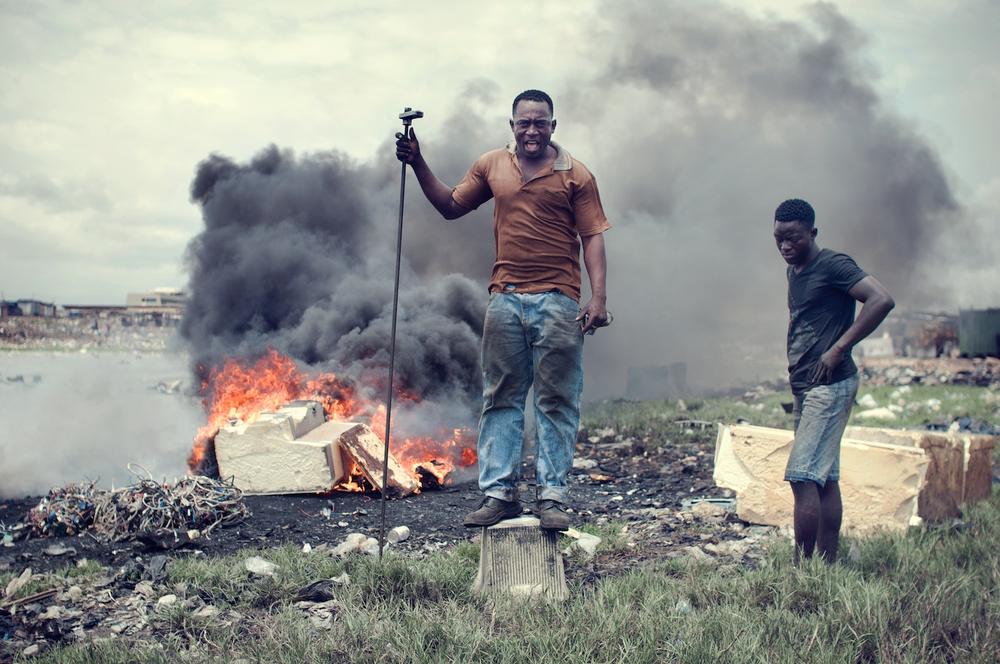
As commonly done in Agbogbloshie, Adam Nasara, 25, uses Styropor from refrigerators to light a fire.
By Kevin McElvaney
Published On 12 Feb 201412 Feb 2014

Agbogbloshie is the world’s biggest e-waste dumpsite and is located close to Accra, Ghana. Electronic waste – TVs, PCs, HiFi systems, refrigerators – defines the landscape of this former wetland and recreation area.

Traders from Europe, US, China and India label their containers as “Development Aid” or “Second-Hand Products”, and in the end, up to 500 containers find their way, illegally, to Tema Harbour, 20 miles east of Agbogbloshie. Customers around the globe expect proper recycling, but illegal dumping became a lucrative business.

Here in Agbogbloshie 7- to 25-year-old boys smash stones and simple tools against TVs and PCs to get to the metals, especially copper. They will earn approximately $2.50 per day. Most of them, hoping for a better future, left their families from the poor northern and upper west regions of Ghana for this kind of work. 

Injuries like burns, untreated wounds, lung problems, eye damage, and back problems go hand in hand with chronic nausea, anorexia, debilitating headaches and respiratory problems. Almost everyone suffers from insomnia. Smoke and invisible toxins (especially cadmium) harm the careless workers because they often don’t know about the risks and walk around in flimsy footwear like flip-flops. Most of them die from cancer while in their 20s.

Besides these horrible facts and circumstances, though, you will find a colourful and spiritual environment with optimistic people. Many young people believe that this is just a temporary situation and hope that they will find their way out of it one day.

Advertisement

Nevertheless Agbogbloshie is a socio-economic and environmental disaster. It is estimated that e-waste dumping in Agbogbloshie will double in 2020. The 40,000 settlers nicknamed this area “Sodom and Gomorrah”.

"What you do to get money, is what kills you," says 20-year-old Idriss Zakarias.
Advertisement
Adjoa, nine, sells small water bags to the boys. They drink it and also use it to extinguish fires.
The Odaw river separates Agbogbloshie from Galaway, where people live, trade and work.
Cows still visit their old grazing grounds and are poisoned by the e-waste.
Ibrahim Abdulai, 23, is a "chief". No-one is working for him, but he is able to decide who is allowed to burn and who does not in this particular area.
Old monitors are used to build bridges. 
Advertisement
Some boys believe that drinking a mixture of liquids can protect them from diseases and illness. This one seems to be a combination of syrup and medicine.
Computers that look like they are in good shape are sold untested to customers in Accra and elsewhere.
Pieter Adongo, 17, shows a Polaroid of himself and his friends, Desmond Atanga, 17, and Sampson Kwabena, 16. 
"Whenever possible I go to school," says Rahman Dauda, 12. Dauda started working here three years ago and always burns e-waste with a few friends.
Agbogbloshie is a playground for Kwabena Labobe, 10. His parents are not able to send him to school and forbid him to burn e-waste.
The eyes of John Mahama, 21, are twitching. He suffers from insomnia and has debilitating headaches, but continues to work.
Women from a nearby market sell fruit to the boys and scrap dealers.
Some boys like Alhassan Adams,19, say they will never burn e-waste and focus their work on collecting tins - metal. They often fall sick with malaria because of the many mosquitos present. 

Related

  • Is the Great Nicobar Island India’s Hormuz-like chokepoint against China?

    Far away from Indian mainland, the government is pumping billions of dollars into a controversial development project.

    Published On 3 Jun 20263 Jun 2026
    great nicobar
  • From: NewsFeed

    Protesters want to send ‘fascists to Mars’ aboard mock rocket

    Environmental activists in Rome built a mock rocket with caricatures of Giorgia Meloni and Donald Trump.

    Published On 31 May 202631 May 2026
    Video Duration 01 minutes 14 seconds play-arrow01:14
  • From: NewsFeed

    Indonesia’s Mount Merapi volcano erupts, spewing ash into the sky

    Videos show Indonesia’s Mount Merapi spewing a column of ash around 2 kilometres high in West Sumatra.

    Published On 30 May 202630 May 2026
    Video Duration 00 minutes 47 seconds play-arrow00:47
  • Poisonous invasion: What is the ‘devil’s trumpet’ harming crops in Iraq?

    The spread of datura is forcing the Iraqi Interior Ministry to urge farmers and citizens to report if spotted.

    Published On 28 May 202628 May 2026
    A Spanish study finds that "Datura" still possesses the potential for further geographic expansion [File: Harry Rose Wikimedia Commons]

More from Gallery

  • Photos: Foreign nationals among 21 dead in New Delhi building fire

    Foreign nationals among 21 dead in New Delhi building fire
    This gallery article has 7 imagescamera7
  • ‘Service is the rent we pay’: Muhammad Ali remembered 10 years on

    Heavyweight champion Muhammad Ali stands over fallen challenger Sonny Liston.
    This gallery article has 9 imagescamera9
  • Photos: Refugee women in CAR face childbirth risks amid US funding cuts

    Refugee women in CAR face childbirth risks amid US funding cuts
    This gallery article has 11 imagescamera11
  • Photos: Protest outside Kenya’s planned US Ebola quarantine centre

    Kenya Ebola
    This gallery article has 7 imagescamera7

Most popular

  • Latest US-Iran clashes test ceasefire; Israeli strikes kill 9 in Gaza City

    WARDANIYEH, LEBANON - JUNE 3: People attend a funeral ceremony held for a family of six, consisting of a father, mother, and four children, who lost their lives in an Israeli strike on the town of Al-Mariwaniyeh, in Wardaniyeh, southern Lebanon, on June 3, 2026. ( Houssam Shbaro - Anadolu Agency )
  • US House passes Iran war powers resolution in rare pushback against Trump

    U.S. House Speaker Mike Johnson (R-LA) speaks during a press conference with Republican House Leadership, on Capitol Hill in Washington, D.C., U.S., June 3, 2026. REUTERS/Nathan Howard
  • Iran war updates: No progress on negotiations with the US – Araghchi

    An Iranian man walks next to an anti-US and Israeli mural
  • Zimbabwe’s e-tricycle crackdown puts rural women’s livelihoods at risk

    Daires Mutamangira and Rejoice Mandipedza in Hauna, Zimbabwe. [Farai Shawn Matiashe/Al Jazeera]

  • About

    • About Us
    • Code of Ethics
    • Terms and Conditions
    • EU/EEA Regulatory Notice
    • Privacy Policy
    • Cookie Policy
    • Cookie Preferences
    • Accessibility Statement
    • Sitemap
    • Work for us
  • Connect

    • Contact Us
    • User Accounts Help
    • Advertise with us
    • Stay Connected
    • Newsletters
    • Channel Finder
    • TV Schedule
    • Podcasts
    • Submit a Tip
    • Paid Partner Content
  • Our Channels

    • Al Jazeera Arabic
    • Al Jazeera English
    • Al Jazeera Investigative Unit
    • Al Jazeera Mubasher
    • Al Jazeera Documentary
    • Al Jazeera Balkans
    • AJ+
  • Our Network

    • Al Jazeera Centre for Studies
    • Al Jazeera Media Institute
    • Learn Arabic
    • Al Jazeera Centre for Public Liberties & Human Rights
    • Al Jazeera Forum
    • Al Jazeera Hotel Partners

Follow Al Jazeera English:

  • facebook
  • twitter
  • youtube
  • instagram-colored-outline
  • rss
Al Jazeera Media Network logo
© 2026 Al Jazeera Media Network