Skip linksSkip to Content
Somalilands herders devastated by drought - Latest News & Updates
Live
Navigation menu
  • News
    • Africa
    • Asia
    • US & Canada
    • Latin America
    • Europe
    • Asia Pacific
  • Middle East
  • Explained
  • Opinion
  • Sport
  • Video
    • Features
    • Economy
    • Human Rights
    • Climate Crisis
    • Investigations
    • Interactives
    • In Pictures
    • Science & Technology
    • Podcasts
    • Travel
play
Live

In Pictures

Gallery|Climate

Somaliland’s herders devastated by drought

As their animals starve to death, thousands of herder families are struggling to survive.
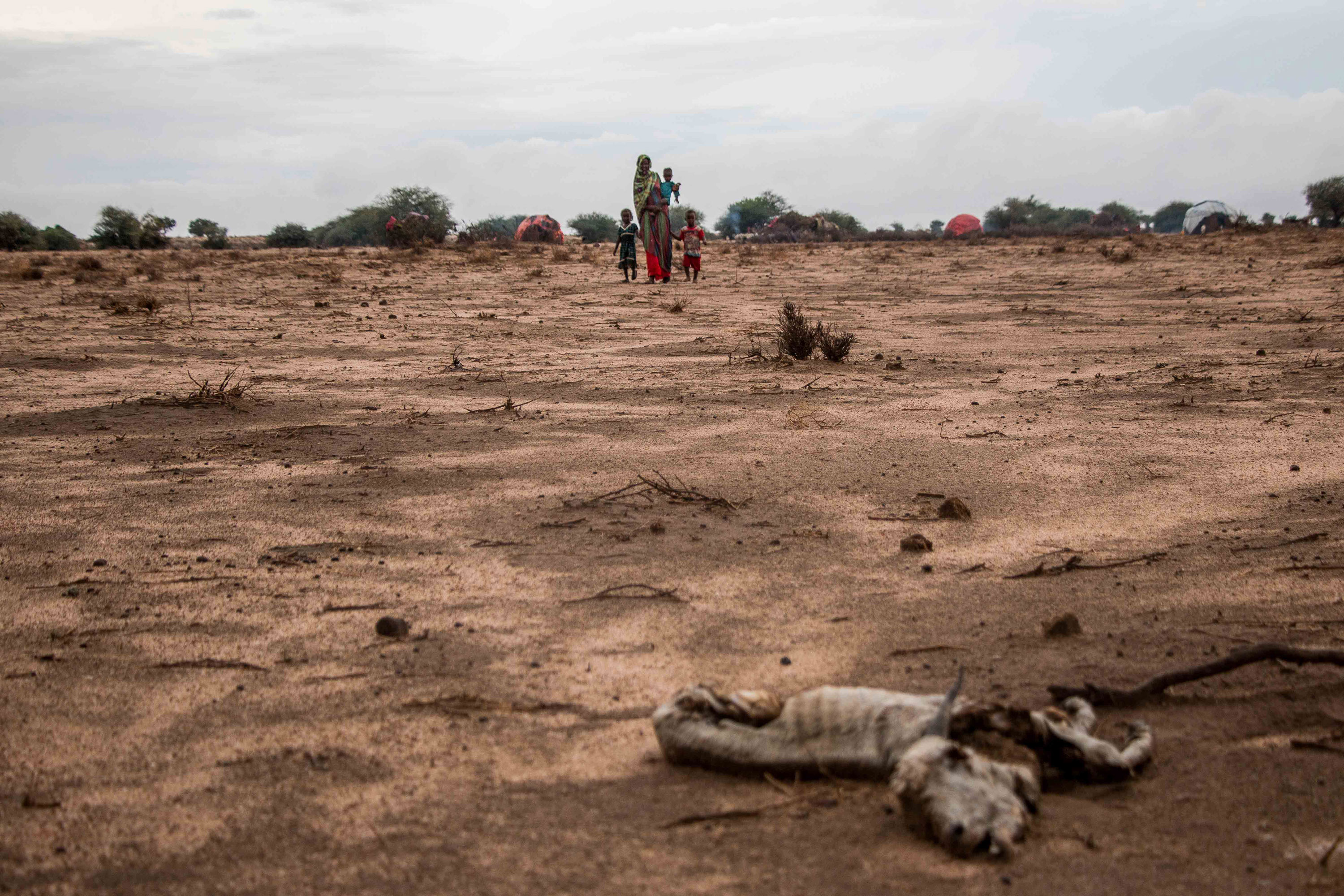
Please Do Not Use/ Somaliland
A herder family living in a bush camp in Somaliland's drought-devastated Awdal region. The camp and others like it across Awdal are scattered with the carcasses of starved livestock. [Ashley Hamer/Al Jazeera]

By Ashley Hamer

Published On 2 Dec 20152 Dec 2015

Share

facebooktwitterwhatsappcopylink

Save

Hargeisa, Somaliland – Vast regions of Somaliland, the autonomous territory that declared independence from Somalia in 1991, but has not been internationally recognised, are enduring one of their harshest droughts in two decades.

As the wet seasons have grown increasingly erratic and the rainfall more sporadic over recent years, thousands of herding families across the remote coastal Awdal and Galbeed territories have been pushed into crisis.


RELATED: Somaliland: A parched earth


These are communities for whom livestock provide the only source of income, but the parched earth means that they are no longer able to feed and hydrate their animals. As a result, their herds are starving to death.

The onset of powerful El Nino weather patterns in November have only exacerbated the current drought. And the forecast for December predicts even more devastation.

Aid groups, including the UN’s humanitarian coordination unit (UNOCHA), warn that the number of people in food security crises across the three territories of greater Somalia – Somaliland, Puntland and South Central Somalia – has increased by 17 percent to around 855,000 people over the past six months.

As of October, the international humanitarian response plan for the whole of Somalia, including Somaliland, is only 36 percent funded.

Please Do Not Use/ Somaliland
In Awdal, pastoralist grandmother Aicha Jama shows the remains of her once 200-strong herd. She says the animals are not diseased but starving to death. The recent and violent start of the rains killed off several of the survivors, which were too weak to withstand the sudden wet and cold. [Ashley Hamer/Al Jazeera]
Advertisement
Please Do Not Use/ Somaliland
The condition of the surviving livestock in Awdal is so poor this year that nobody can trade live animals or even sell milk or meat. Families are sinking into debt after borrowing money and food rations from residents of the towns. [Ashley Hamer/Al Jazeera]
Please Do Not Use/ Somaliland
A Somaliland police escort stands on the desolate beach at Lughaya, Awdal. This coastline was buffeted by stormy seas after Cyclone Chapala in early November. Up to 25 fishing boats, hundreds of nets, and several structures were destroyed. [Ashley Hamer/Al Jazeera]
Please Do Not Use/ Somaliland
A displaced man stands outside his hut with his two remaining animals. Towns like Lughaya in Awdal are sheltering growing numbers of internally displaced persons [IDP] who are forced to abandon their pastoral way of life after their livestock herds had been decimated by drought. They have no alternative source of income. [Ashley Hamer/Al Jazeera]
Please Do Not Use/ Somaliland
According to aid groups, the number of people in crisis and with emergency levels of food insecurity has increased by 17 percent to 855,000 over the past six months. [Ashley Hamer/Al Jazeera]
Please Do Not Use/ Somaliland
Shukri Barre, a 20-year-old, eight-month-pregnant mother of two, stands with her son and the remains of her flock of goats. She says she also owned more than 200 shoats, but only 20 have survived the drought. She moved to the village of Kalowle in Awdal three months ago because she could no longer find water. [Ashley Hamer/Al Jazeera]
Advertisement
Please Do Not Use/ Somaliland
The carcasses of emaciated livestock litter pastoralist camps in Awdal region. According to the UN's Food and Agriculture Organization [UNFAO], between 35 and 40 percent of sheep and goats have died this year. [Ashley Hamer/Al Jazeera]
Please Do Not Use/ Somaliland
In the village of Osoli, Awdal, a man packs rations onto the back of a camel. Families here say they received aid from Islamic charities and the Christian aid group, World Vision, which distributes sacks of flour, sugar, oil, powdered milk and rice, as well as conducting malnutrition screenings for children. [Ashley Hamer/Al Jazeera]
Please Do Not Use/ Somaliland
Outside the drought zone and close to the capital Hargeisa, UNFAO veterinary teams assist the Ministry of Livestock with vaccinating sheep, goats, cattle and camels. Animals weakened through malnutrition are more susceptible to disease. The vaccination teams aim to vaccinate three million animals across Somaliland over two months. [Ashley Hamer/Al Jazeera]
Please Do Not Use/ Somaliland
A young shepherd tends to her flock about a two-hour drive outside Somaliland's capital, Hargeisa. Livestock has been less affected by drought in this region, and pastoralist families have managed to make some money from the trade of their herds this season. [Ashley Hamer/Al Jazeera]
Please Do Not Use/ Somaliland
Livestock production is the backbone of Somaliland's economy. Around 60 percent of the population practises some form of pastoralism or depends on animal products, primarily because the arid regional climate only allows for a few alternative livelihoods. [Ashley Hamer/Al Jazeera]
Please Do Not Use/ Somaliland
Grandmother Maria Abdullahi is a resident of Nasa Hablod's IDP community on the outskirts of Hargeisa. Most families living in this informal settlement come from the minority Gabooye clan. They say they are herders displaced to the city due to worsening droughts which killed off their livestock. 'We moved here because our chances in the city are somehow better ... In the countryside, my husband could not find money for us. Here, he collects rocks. And I can go downtown and sell fabrics that I sew.' [Ashley Hamer/Al Jazeera]
Please Do Not Use/ Somaliland
Nasa Hablod is an informal, ragged settlement overlooking the capital Hargeisa, built by families who were displaced by droughts over the past five years. Whereas some IDP and refugee settlements receive aid, Nasa Hablod is neglected, with its population lacking even the most basic services. [Ashley Hamer/Al Jazeera]

Related

  • Survivors recall terror of landslides from North Sumatra cyclone

    Landslides flatten homes in North Sumatra, leaving families fearing every noise and hoping for safer futures.

    Published On 4 Dec 20254 Dec 2025
    Many survivors are looking for their missing loved ones. Some were carried away by floodwaters, others buried under the mud.
    This gallery article has 14 imagescamera14
  • From: NewsFeed

    Indonesian villages flattened by catastrophic floods

    Aerial footage shows villages in North Sumatra buried in mud after catastrophic floods and landslides

    Published On 3 Dec 20253 Dec 2025
    This picture shows an aerial view of villagers wading through the mudflow to find a shelter in the aftermath of flash floods in Tukka village, Central Tapanuli, North Sumatra province on Dec. 3, 2025. [Y.T Haryono/AFP]
    Video Duration 00 minutes 58 seconds play-arrow00:58
  • From: Quotable

    Record Asia floods proof “we need to wake up” on climate

    “The world needs to wake up. We need to adapt.”

    Published On 2 Dec 20252 Dec 2025
    Fredolin Tangang | Climatologist
    Video Duration 01 minutes 09 seconds play-arrow01:09
  • Jamaica secures $6.7bn for hurricane recovery and reconstruction plan

    Up to $3.6bn in government financing included, with major contributions from global financial institutions.

    Published On 1 Dec 20251 Dec 2025
    FILE PHOTO: A fisherman fixes his boat, damaged by Hurricane Melissa, on Treasure Beach, in St. Elizabeth, Jamaica, November 5, 2025. REUTERS/Raquel Cunha/File Photo

More from Gallery

  • Survivors recall terror of landslides from North Sumatra cyclone

    Many survivors are looking for their missing loved ones. Some were carried away by floodwaters, others buried under the mud.
    This gallery article has 14 imagescamera14
  • Photos: Gaza university resumes in-person classes

    Gaza University
    This gallery article has 7 imagescamera7
  • Photos: Pope prays at site of 2020 Beirut port explosion

    Pope Leo XIV visit to Lebanon
    This gallery article has 7 imagescamera7
  • Photos: Recovery under way after floods in Indonesia, Sri Lanka, Thailand

    Rescuers move people to safety on a small boat in a flooded area.
    This gallery article has 8 imagescamera8

Most popular

  • ‘Uninterrupted oil shipments’: Key takeaways from Putin-Modi talks in Delhi

    Russia's President Vladimir Putin and India's Prime Minister Narendra Modi are seen after their talks at Hyderabad House in New Delhi on December 5, 2025 [Alexander Kazakov/Sputnik/Pool via AFP]
  • Infantino’s ‘Peace Prize’ to Trump raises questions about FIFA’s neutrality

    Trump and Infantino
  • FIFA World Cup 2026 draw – updates

    A picture shows groups A, B, C, D, E, F, G, H, I, J, K and L during the draw for the 2026 FIFA Football World Cup taking place in the US, Canada and Mexico, at the Kennedy Center, in Washington, DC, on December 5, 2025. (Photo by Mandel NGAN / POOL / AFP)
  • Pakistan seeks new South Asian bloc to cut India out: Will it work?

    Mohammad Touhid Hossain, foreign affairs adviser of Bangladesh's interim government and Ishaq Dar, Pakistan's foreign minister, attend a bilateral meeting in Dhaka, Bangladesh [File: Bangladesh's Ministry of Foreign Affairs/Handout via Reuters]

  • About

    • About Us
    • Code of Ethics
    • Terms and Conditions
    • EU/EEA Regulatory Notice
    • Privacy Policy
    • Cookie Policy
    • Cookie Preferences
    • Accessibility Statement
    • Sitemap
    • Work for us
  • Connect

    • Contact Us
    • User Accounts Help
    • Advertise with us
    • Stay Connected
    • Newsletters
    • Channel Finder
    • TV Schedule
    • Podcasts
    • Submit a Tip
    • Paid Partner Content
  • Our Channels

    • Al Jazeera Arabic
    • Al Jazeera English
    • Al Jazeera Investigative Unit
    • Al Jazeera Mubasher
    • Al Jazeera Documentary
    • Al Jazeera Balkans
    • AJ+
  • Our Network

    • Al Jazeera Centre for Studies
    • Al Jazeera Media Institute
    • Learn Arabic
    • Al Jazeera Centre for Public Liberties & Human Rights
    • Al Jazeera Forum
    • Al Jazeera Hotel Partners

Follow Al Jazeera English:

  • facebook
  • twitter
  • youtube
  • instagram-colored-outline
  • rss
Al Jazeera Media Network logo
© 2025 Al Jazeera Media Network