Skip linksSkip to Content
Endangered camel caravans of the ethiopian salt mines - Latest News & Updates
Live
Navigation menu
  • News
    • Africa
    • Asia
    • US & Canada
    • Latin America
    • Europe
    • Asia Pacific
  • Middle East
  • Explained
  • Opinion
  • Sport
  • Video
    • Features
    • Economy
    • Human Rights
    • Climate Crisis
    • Investigations
    • Interactives
    • In Pictures
    • Science & Technology
    • Podcasts
    • Travel
play
Live

In Pictures

Gallery|Business and Economy

Endangered camel caravans of the Ethiopian salt mines

Arrival of big companies and technology advances, threaten ancient livelihood at Ethiopia’s dried, salty inland seabed.
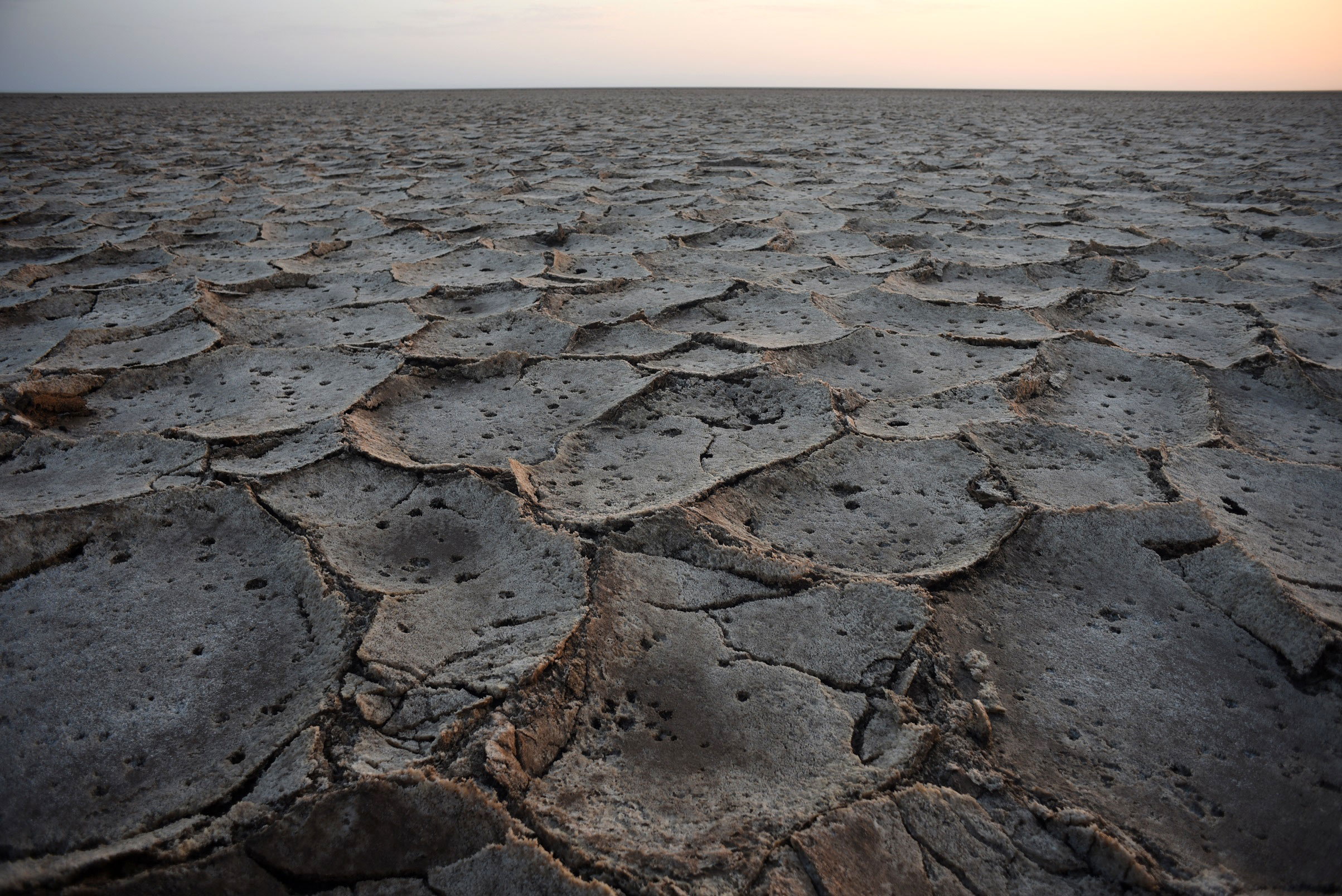
Ethiopian salt mines and camel caravans/Please Do Not Use
The salt flats of the Danakil Depression were formed tens of thousands of years ago by the evaporation of an inland sea. [Jason Patinkin/Al Jazeera]

By Jason Patinkin

Published On 13 Jan 201613 Jan 2016

Share

facebooktwitterwhatsappcopylink

Save

Danakil, Ethiopia – Salt miners ply an ancient and gruelling trade in Ethiopia’s northeastern Danakil Depression, one of the hottest and lowest places on Earth.

Danakil contains vast salt flats as well as sulphur springs and rumbling volcanoes created by the grinding of three tectonic plates. Yet this inhospitable landscape manages to support the Afar people, a Muslim group straddling the borderlands of Ethiopia, Eritrea, and Djibouti.

Each day, Afar miners chop salt from the earth under a blistering sun, then load the minerals on to camels and donkeys which march for days to market towns to the west where the mineral is sold.

Danakil salt was once so valuable people used it as currency, but each rough hewn slab fetches only four Ethiopian birr (about 20 cents) at the mine today. With such small profits for such hard labour, the ancient trade may soon give way to more lucrative pursuits.

The Danakil also holds large deposits of potash which is used in fertilisers, and numerous mining companies are lining up to begin extraction.


READ MORE: Ethiopia’s tourism industry


A railway being built from Djibouti and a new tarmacked road traversing the old salt route may soon render the traditional camel caravan obsolete. Until then, the Afar miners will continue their tough way of life, scratching a living from this desolate stretch of salt.

Ethiopian salt mines and camel caravans/Please Do Not Use
Salt miners have come to inhospitable land for generations to extract the precious resource. [Jason Patinkin/Al Jazeera]
Advertisement
Ethiopian salt mines and camel caravans/Please Do Not Use
Simple axes are used to cut large slabs of salt, which are then pried out using wooden poles. [Jason Patinkin/Al Jazeera]
Ethiopian salt mines and camel caravans/Please Do Not Use
Other miners use hand tools to shave the slabs into bricks which are loaded on to the backs of camels. Each brick costs four Ethiopian birr, about 20 cents. [Jason Patinkin/Al Jazeera]
Ethiopian salt mines and camel caravans/Please Do Not Use
Up to 30 bricks of salt are loaded on to each camel. The weight of each load is sometimes so much that even these sturdy beasts collapse under it. [Jason Patinkin/Al Jazeera]
Ethiopian salt mines and camel caravans/Please Do Not Use
The camels and their keepers walk for one to two days from the low-lying mines to a salt trading town called Berhale in nearby mountains. [Jason Patinkin/Al Jazeera]
Ethiopian salt mines and camel caravans/Please Do Not Use
In Berhale, the camel's load of salt is traded and the caravan turns around for the return journey to the mines. [Jason Patinkin/Al Jazeera]
Advertisement
Ethiopian salt mines and camel caravans/Please Do Not Use
On rare occasions, the salt flats flood with a few inches of water when sustained winds push water from a nearby lake across the depression. [Jason Patinkin/Al Jazeera]
Ethiopian salt mines and camel caravans/Please Do Not Use
Depending on the time of day, the salt can take on a pink, grey, or white appearance. [Jason Patinkin/Al Jazeera]
Ethiopian salt mines and camel caravans/Please Do Not Use
Most Afar people are pastoralists who herd camels, sheep, donkeys, and cattle, but a minority make their livelihood from the salt business. [Jason Patinkin/Al Jazeera]
Ethiopian salt mines and camel caravans/Please Do Not Use
In the summer, temperatures in the Danakil Depression can reach 45C. Even in winter, the daytime temperature can top 35C. [Jason Patinkin/Al Jazeera]
Ethiopian salt mines and camel caravans/Please Do Not Use
A fast-working salt miner can produce dozens of finished bricks at a time. [Jason Patinkin/Al Jazeera]

Related

  • Egypt’s economy stabilises, but poverty challenges persist

    Investments boost Egypt’s economy, but rural poverty highlights unequal benefits from economic recovery efforts.

    Published On 5 Dec 20255 Dec 2025
    Investments are pouring into Egypt, as well as international loans, but the poor complain that subsidies have been removed [Amr Abdallah Dalsh/Reuters] (Reuters)
  • Starbucks, union workers face off as old tensions over wages spill over

    Hundreds of baristas launched an an open ended strike across the United States, some joined by politicians.

    Published On 5 Dec 20255 Dec 2025
    Picketers lined New York’s Fifth Avenue calling for better working conditions at Starbucks [Andy Hirschfeld/Al Jazeera]
  • Netflix to acquire Warner Bros Discovery, raising antitrust concerns

    Critics say the deal would create less competition in Hollywood and limit choice for consumers.

    Published On 5 Dec 20255 Dec 2025
    The deal comes after a bidding war between Netflix and Paramount-Skydance, the owner of CBS News [File: Mike Blake/Reuters]
  • Pakistan seeks new South Asian bloc to cut India out: Will it work?

    Pakistan says an emerging three-way cooperation with Bangladesh and China could be ‘expanded and duplicated’.

    Published On 5 Dec 20255 Dec 2025
    Mohammad Touhid Hossain, foreign affairs adviser of Bangladesh's interim government and Ishaq Dar, Pakistan's foreign minister, attend a bilateral meeting in Dhaka, Bangladesh [File: Bangladesh's Ministry of Foreign Affairs/Handout via Reuters]

More from Gallery

  • Survivors recall terror of landslides from North Sumatra cyclone

    Many survivors are looking for their missing loved ones. Some were carried away by floodwaters, others buried under the mud.
    This gallery article has 14 imagescamera14
  • Photos: Gaza university resumes in-person classes

    Gaza University
    This gallery article has 7 imagescamera7
  • Photos: Pope prays at site of 2020 Beirut port explosion

    Pope Leo XIV visit to Lebanon
    This gallery article has 7 imagescamera7
  • Photos: Recovery under way after floods in Indonesia, Sri Lanka, Thailand

    Rescuers move people to safety on a small boat in a flooded area.
    This gallery article has 8 imagescamera8

Most popular

  • Infantino’s ‘Peace Prize’ to Trump raises questions about FIFA’s neutrality

    Trump and Infantino
  • FIFA World Cup 2026 draw – updates

    A picture shows groups A, B, C, D, E, F, G, H, I, J, K and L during the draw for the 2026 FIFA Football World Cup taking place in the US, Canada and Mexico, at the Kennedy Center, in Washington, DC, on December 5, 2025. (Photo by Mandel NGAN / POOL / AFP)
  • Arab, Muslim nations reject Israel exit-only plan for Gaza Rafah crossing

    Rafah crossing, Gaza
  • ‘Uninterrupted oil shipments’: Key takeaways from Putin-Modi talks in Delhi

    Russia's President Vladimir Putin and India's Prime Minister Narendra Modi are seen after their talks at Hyderabad House in New Delhi on December 5, 2025 [Alexander Kazakov/Sputnik/Pool via AFP]

  • About

    • About Us
    • Code of Ethics
    • Terms and Conditions
    • EU/EEA Regulatory Notice
    • Privacy Policy
    • Cookie Policy
    • Cookie Preferences
    • Accessibility Statement
    • Sitemap
    • Work for us
  • Connect

    • Contact Us
    • User Accounts Help
    • Advertise with us
    • Stay Connected
    • Newsletters
    • Channel Finder
    • TV Schedule
    • Podcasts
    • Submit a Tip
    • Paid Partner Content
  • Our Channels

    • Al Jazeera Arabic
    • Al Jazeera English
    • Al Jazeera Investigative Unit
    • Al Jazeera Mubasher
    • Al Jazeera Documentary
    • Al Jazeera Balkans
    • AJ+
  • Our Network

    • Al Jazeera Centre for Studies
    • Al Jazeera Media Institute
    • Learn Arabic
    • Al Jazeera Centre for Public Liberties & Human Rights
    • Al Jazeera Forum
    • Al Jazeera Hotel Partners

Follow Al Jazeera English:

  • facebook
  • twitter
  • youtube
  • instagram-colored-outline
  • rss
Al Jazeera Media Network logo
© 2025 Al Jazeera Media Network