Skip linksSkip to Content
Nowhere to run for the children of south sudan - Latest News & Updates
Live
Navigation menu
  • News
    • Africa
    • Asia
    • US & Canada
    • Latin America
    • Europe
    • Asia Pacific
  • Middle East
  • Explained
  • Opinion
  • Sport
  • Video
    • Features
    • Economy
    • Human Rights
    • Climate Crisis
    • Investigations
    • Interactives
    • In Pictures
    • Science & Technology
    • Podcasts
    • Travel
play
Live

In Pictures

Gallery|Humanitarian Crises

Nowhere to run for the children of South Sudan

An estimated number of 900,000 children have been displaced by the on-going war in South Sudan.
Nowhere to run for the children of South Sudan / Please DO Not Use
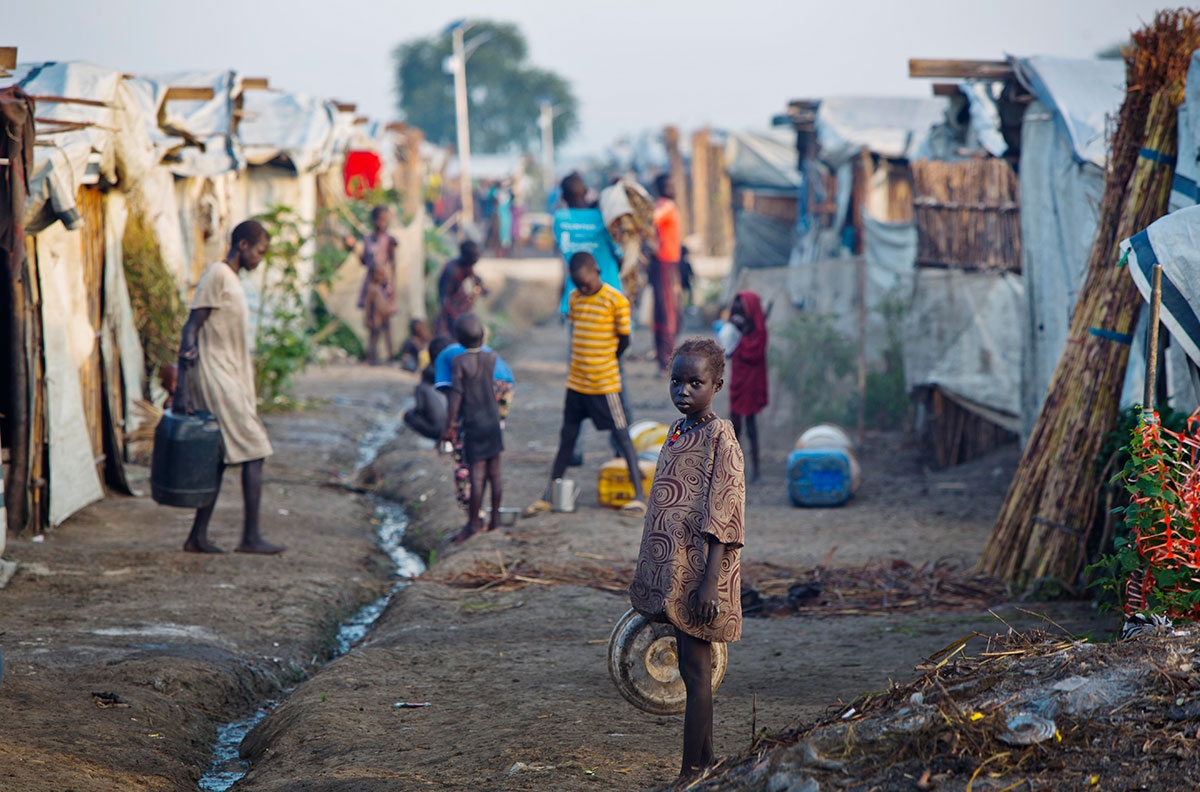
A young girl stands in front of the temporary shelter where she now lives in the UN Protection of Civilian Camp (POC) Bentiu, in South Sudan. Almost 2,000 children have been killed or maimed in the past three years. [Kate Holt/UNICEF]

By Kate Holt

Published On 15 Dec 201615 Dec 2016

Share

facebooktwitterwhatsappcopylink

Save

South Sudan – Seven-year-old Nyajima still thinks about when the soldiers came to her village. The fighting had been getting closer each day.

“Many people who lived in our village were killed,” she says. “The soldiers stole all the food and left us with nothing except our saucepans, so we took them and started to walk to the POC.”  This was the Protection of Civilian Camp run by the UN peacekeeping force UNMISS. “It was a long walk and one night we slept outside on the way. This dress I am wearing is the only dress that I have.”

Nyajima is just one of thousands of children to have been displaced by the on-going war in South Sudan: a recent report from UNICEF estimated the number at 900,000 since the conflict between forces loyal to President Salva Kiir and those who support the once vice-president, Riek Machar began in 2013.

She is one of the lucky ones – her family all survived and now live in a UN protected camp in Bentiu. “Once we lived in a house made of bamboo – now we live in a house of plastic sheeting,” she says.

Children are the biggest victims of the conflict: 17, 000 of them are reported to have been recruited by armed forces and armed groups looking for child soldiers to fuel the conflict which has been going on since 2013; another 14,000 are registered as unaccompanied or missing; and more than 2,000 have been killed or maimed during this time.

“Before this conflict my life was very good,” says Bol, an 11-year-old boy.

“Then government forces came to my village on an island in Leer County where I lived. They chased us into the water up to our chins and my younger brother was killed. I got separated from my parents and they still don’t know where I am.”

Advertisement

Bol himself only escaped thanks to the intervention of an older soldier. “They shot my brother. I was crying then one of them put a gun to my head but the older man asked them what they were doing killing small boys, so they let me go and stole my cows instead.” 

READ MORE: UN – ‘Ethnic cleansing under way’ in South Sudan

Nowhere to run for the children of South Sudan / Please DO Not Use
Nyajima, who is seven years old and who is newly arrived, helps to feed her younger sister who is disabled. Their father was killed in fighting in Unity State between government soldiers and rebel factions and her mother, disabled younger sister and brother all fled to Bentiu. Nyambur is not able to go to school because she has to look after her sister. [Kate Holt/UNICEF]
Advertisement
Nowhere to run for the children of South Sudan / Please DO Not Use
A woman watches as a UN peacekeeping foot patrol marches past her as she washes clothes in a river. An estimated 900,000 children have been displaced since the conflict started. [Kate Holt/UNICEF]
Nowhere to run for the children of South Sudan / Please DO Not Use
A malaria sufferer sits on a bed waiting to have a drip put in at a health clinic in Malakal. The town was once a thriving economic centre and the second largest city in South Sudan. Fighting between government forces and opposition fighters has destroyed it and the majority of its population has fled. [Kate Holt/UNICEF]
Nowhere to run for the children of South Sudan / Please DO Not Use
Thousands of people have fled Leer in recent weeks as fighting intensifies between rebel and government soldiers, heading to the Bentiu camp, which is protected by UN soldiers. [Kate Holt/UNICEF]
Nowhere to run for the children of South Sudan / Please DO Not Use
People displaced by the fighting in Unity State go about their daily lives at the in the UN-protected camp in Bentiu. [Kate Holt/UNICEF]
Nowhere to run for the children of South Sudan / Please DO Not Use
A woman washes her baby outside their temporary home. Some 14,000 children are registered as unaccompanied or missing. [Kate Holt/UNICEF]
Advertisement
Nowhere to run for the children of South Sudan / Please DO Not Use
A young boy and his brother sit in their family's traditional hut in the town of Kuach in Unity State. UNICEF is assessing hygiene facilities in remote towns because there have been several confirmed cases of cholera in the region and renewed fighting is making humanitarian access difficult. [Kate Holt/UNICEF]
Nowhere to run for the children of South Sudan / Please DO Not Use
A woman sits with her baby under a mosquito net. This year alone UNICEF and partners have admitted 184,000 children with severe malnutrition for treatment. [Kate Holt/UNICEF]
Nowhere to run for the children of South Sudan / Please DO Not Use
Young boys watch a football match and film it with their phone in the camp at Bentiu. [Kate Holt/UNICEF]
Nowhere to run for the children of South Sudan / Please DO Not Use
Women attend a church service in the UN protected camp at Bentiu, which is now home to 105,000 people. [Kate Holt/UNICEF]
Nowhere to run for the children of South Sudan / Please DO Not Use
A young girl runs to school along a ridge in the Benitu camp. Nearly two million children are missing out of school. [Kate Holt/UNICEF]
Nowhere to run for the children of South Sudan / Please DO Not Use
A baby reaches out to touch children through a fence that divides the Malkal camp into different parts. The fence separates two ethnic groups. More than 33,000 people from the Nuer and Shiluk tribes are now living in the camp. [Kate Holt/UNICEF]
Nowhere to run for the children of South Sudan / Please DO Not Use
A boy walks by a dirty stream. In 2016 Unicef reunited 4,500 children with their families. UNICEF is supporting children in the camp providing services ranging from education to nutrition, in partnership with other international organisations. [Kate Holt/UNICEF]
Nowhere to run for the children of South Sudan / Please DO Not Use
The UN-protected camp at Malakal, in South Sudan. [Kate Holt/UNICEF]

Related

  • UN: South Sudan on brink of ethnic civil war

    Rights commission urges international community to take immediate action in South Sudan to avoid “all-out ethnic war”.

    Published On 14 Dec 201614 Dec 2016
    Christine Elia, 27, holds her twin sons at a displaced persons camp protected by U.N. peacekeepers in Wau, South Sudan
  • One year after peace deal, South Sudan ‘worse off’

    On anniversary of South Sudan’s peace deal, the head of the agreement’s monitoring body says fighting halted progress.

    Published On 27 Aug 201627 Aug 2016
    Botswana

More from Gallery

  • Survivors recall terror of landslides from North Sumatra cyclone

    Many survivors are looking for their missing loved ones. Some were carried away by floodwaters, others buried under the mud.
    This gallery article has 14 imagescamera14
  • Photos: Gaza university resumes in-person classes

    Gaza University
    This gallery article has 7 imagescamera7
  • Photos: Pope prays at site of 2020 Beirut port explosion

    Pope Leo XIV visit to Lebanon
    This gallery article has 7 imagescamera7
  • Photos: Recovery under way after floods in Indonesia, Sri Lanka, Thailand

    Rescuers move people to safety on a small boat in a flooded area.
    This gallery article has 8 imagescamera8

Most popular

  • ‘Uninterrupted oil shipments’: Key takeaways from Putin-Modi talks in Delhi

    Russia's President Vladimir Putin and India's Prime Minister Narendra Modi are seen after their talks at Hyderabad House in New Delhi on December 5, 2025 [Alexander Kazakov/Sputnik/Pool via AFP]
  • Infantino’s ‘Peace Prize’ to Trump raises questions about FIFA’s neutrality

    Trump and Infantino
  • FIFA World Cup 2026 draw – updates

    A picture shows groups A, B, C, D, E, F, G, H, I, J, K and L during the draw for the 2026 FIFA Football World Cup taking place in the US, Canada and Mexico, at the Kennedy Center, in Washington, DC, on December 5, 2025. (Photo by Mandel NGAN / POOL / AFP)
  • Pakistan seeks new South Asian bloc to cut India out: Will it work?

    Mohammad Touhid Hossain, foreign affairs adviser of Bangladesh's interim government and Ishaq Dar, Pakistan's foreign minister, attend a bilateral meeting in Dhaka, Bangladesh [File: Bangladesh's Ministry of Foreign Affairs/Handout via Reuters]

  • About

    • About Us
    • Code of Ethics
    • Terms and Conditions
    • EU/EEA Regulatory Notice
    • Privacy Policy
    • Cookie Policy
    • Cookie Preferences
    • Accessibility Statement
    • Sitemap
    • Work for us
  • Connect

    • Contact Us
    • User Accounts Help
    • Advertise with us
    • Stay Connected
    • Newsletters
    • Channel Finder
    • TV Schedule
    • Podcasts
    • Submit a Tip
    • Paid Partner Content
  • Our Channels

    • Al Jazeera Arabic
    • Al Jazeera English
    • Al Jazeera Investigative Unit
    • Al Jazeera Mubasher
    • Al Jazeera Documentary
    • Al Jazeera Balkans
    • AJ+
  • Our Network

    • Al Jazeera Centre for Studies
    • Al Jazeera Media Institute
    • Learn Arabic
    • Al Jazeera Centre for Public Liberties & Human Rights
    • Al Jazeera Forum
    • Al Jazeera Hotel Partners

Follow Al Jazeera English:

  • facebook
  • twitter
  • youtube
  • instagram-colored-outline
  • rss
Al Jazeera Media Network logo
© 2025 Al Jazeera Media Network