Skip linksSkip to Content
Migrant domestic workers take to the streets in beirut - Latest News & Updates
Live
Navigation menu
  • News
    • Africa
    • Asia
    • US & Canada
    • Latin America
    • Europe
    • Asia Pacific
  • Middle East
  • Explained
  • Opinion
  • World Cup
  • Video
    • Features
    • Economy
    • Sport
    • Human Rights
    • Climate Crisis
    • Investigations
    • Interactives
    • In Pictures
    • Science & Technology
    • Podcasts
    • Travel
play
Live

In Pictures

Gallery

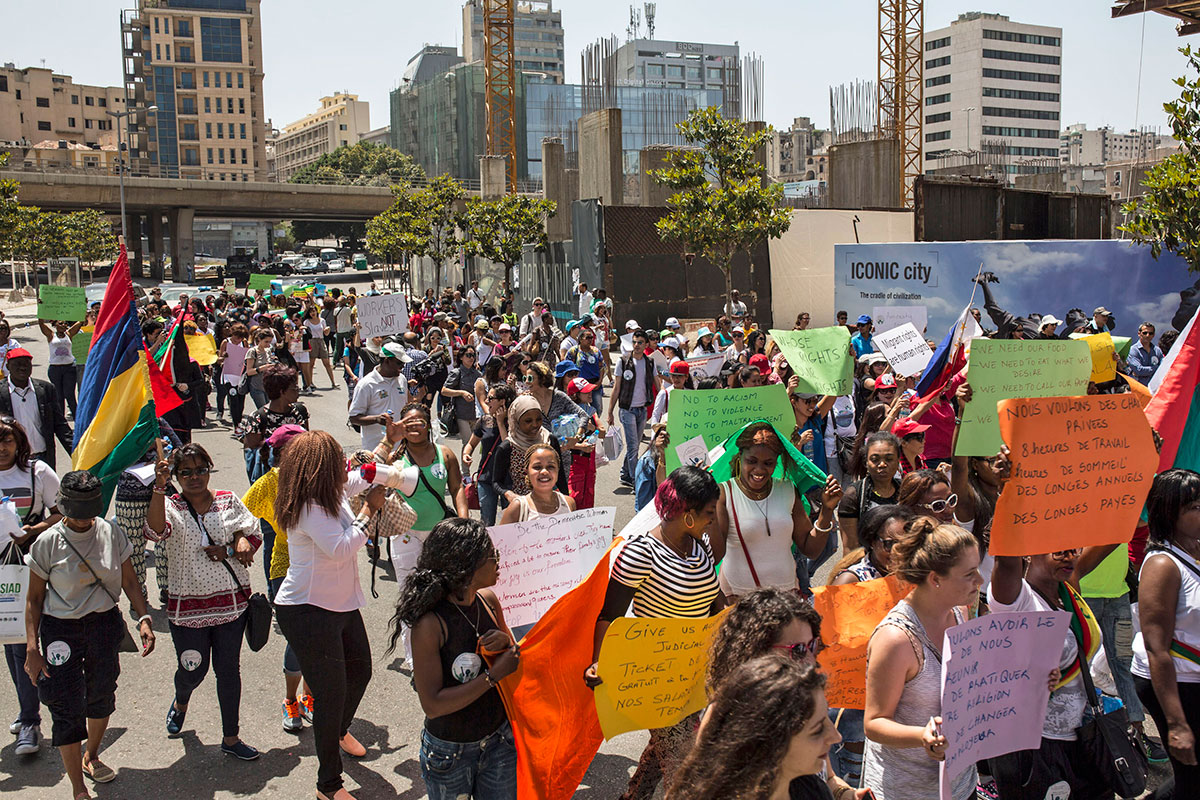
Migrant domestic workers take to the streets in Beirut

Demonstrators called for basic rights, including a minimum wage and at least one day off per week.
Save

Share

facebookxwhatsapp-strokecopylink
Domestic workers take the streets in Beirut/ Please Do Not Use
Hundreds of migrant domestic workers marched in Beirut to mark International Workers' Day. They were joined by allies and supporters. [Anne Paq/Al Jazeera]
By Anne Paq
Published On 7 May 20167 May 2016

Hundreds of migrant domestic workers marched in the Lebanese capital Beirut this week to mark International Workers’ Day and to denounce their own working conditions. The demonstrators called for the implementation of ILO Convention 189, which stipulates that domestic workers have the right to at least one day off per week and a minimum wage.

Of the 200,000 migrant domestic workers in Lebanon, most work as live-in maids, and they primarily hail from the Philippines, Ethiopia, Bangladesh, Sri Lanka and Nepal. They cannot enter or leave the country for any reason without obtaining explicit written permission from their employer, making them vulnerable to exploitation.

Some of the most blatant violations of the rights of migrant domestic workers in Lebanon include excessive working hours, withholding of salaries, beatings and sexual abuse, and withholding of passports to prevent them from leaving. However, the workers are not protected by Lebanese labour laws. Last year, in an effort to improve their situation, migrant domestic workers in Lebanon moved to form their own labour union.

Domestic workers take the streets in Beirut/ Please Do Not Use
According to a study by the human rights group KAFA, 62 percent of migrant domestic workers work between 16 and 20 hours a day and are unable to take breaks. [Anne Paq/Al Jazeera]
Advertisement
Domestic workers take the streets in Beirut/ Please Do Not Use
Many of the workers are locked in the houses of their employers with their identity papers confiscated. They are also forced to wear uniforms. [Anne Paq/Al Jazeera]
Domestic workers take the streets in Beirut/ Please Do Not Use
The workers marched to mark International Workers' day for the seventh year in a row. [Anne Paq/Al Jazeera]
Domestic workers take the streets in Beirut/ Please Do Not Use
'Our rights have to be respected. I know too many people who have big problems. I know someone who is at the hospital. She was tortured with electricity. We have to shout for our rights,' said Samuel, a domestic male worker from Ethiopia. [Anne Paq/Al Jazeera]
Domestic workers take the streets in Beirut/ Please Do Not Use
Demonstrators demanded the ratification and implementation of ILO Convention 189, which provides basic protections for domestic workers. [Anne Paq/Al Jazeera]
Domestic workers take the streets in Beirut/ Please Do Not Use
'I am here because of the money issue. The salaries are too low. I work 24 hours a day. I have only one Sunday off every two weeks and I get paid just $200 per month,' said Binta, from Mali. [Anne Paq/Al Jazeera]
Advertisement
Domestic workers take the streets in Beirut/ Please Do Not Use
'I feel good today. We are here, all the workers, to ask for justice. We want better salaries and Sundays off. There is a lot of racism in the Lebanese society,' said Melinda, from the island of Mauritius. [Anne Paq/Al Jazeera]
Domestic workers take the streets in Beirut/ Please Do Not Use
According to the KAFA study, 82 percent of the female workers found themselves coerced into forced labour. [Anne Paq/Al Jazeera]
Domestic workers take the streets in Beirut/ Please Do Not Use
Migrant domestic workers in Lebanon moved to form a union early last year, the first of its kind in the Arab world. To date, it has not been recognised by the Lebanese government. [Anne Paq/Al Jazeera]
Domestic workers take the streets in Beirut/ Please Do Not Use
'We are totally dependent on the employers. For 20 years now, my employer has had my passport. I want to go. But I do not know what to do. In 20 years, I only went back once to my country. My mother is dead, my daughter is dead, and I have not seen them. I want justice. I want to go home," said Jackie, from Mauritius. [Anne Paq/Al Jazeera]
Domestic workers take the streets in Beirut/ Please Do Not Use
Demonstrators demanded an end to the kafala system, under which their legal status is dependent on their employers. [Anne Paq/Al Jazeera]
Domestic workers take the streets in Beirut/ Please Do Not Use
'I feel very happy because we are united today,' said Evangila, from the Philippines. This week's march ended with speeches and dances. [Anne Paq/Al Jazeera]

More from Gallery

  • Photos: Foreign nationals among 21 dead in New Delhi building fire

    Foreign nationals among 21 dead in New Delhi building fire
    This gallery article has 7 imagescamera7
  • ‘Service is the rent we pay’: Muhammad Ali remembered 10 years on

    Heavyweight champion Muhammad Ali stands over fallen challenger Sonny Liston.
    This gallery article has 9 imagescamera9
  • Photos: Refugee women in CAR face childbirth risks amid US funding cuts

    Refugee women in CAR face childbirth risks amid US funding cuts
    This gallery article has 11 imagescamera11
  • Photos: Protest outside Kenya’s planned US Ebola quarantine centre

    Kenya Ebola
    This gallery article has 7 imagescamera7

Most popular

  • Latest US-Iran clashes test ceasefire; Israeli strikes kill 9 in Gaza City

    WARDANIYEH, LEBANON - JUNE 3: People attend a funeral ceremony held for a family of six, consisting of a father, mother, and four children, who lost their lives in an Israeli strike on the town of Al-Mariwaniyeh, in Wardaniyeh, southern Lebanon, on June 3, 2026. ( Houssam Shbaro - Anadolu Agency )
  • US House passes Iran war powers resolution in rare pushback against Trump

    U.S. House Speaker Mike Johnson (R-LA) speaks during a press conference with Republican House Leadership, on Capitol Hill in Washington, D.C., U.S., June 3, 2026. REUTERS/Nathan Howard
  • Iran war updates: No progress on negotiations with the US – Araghchi

    An Iranian man walks next to an anti-US and Israeli mural
  • Zimbabwe’s e-tricycle crackdown puts rural women’s livelihoods at risk

    Daires Mutamangira and Rejoice Mandipedza in Hauna, Zimbabwe. [Farai Shawn Matiashe/Al Jazeera]

  • About

    • About Us
    • Code of Ethics
    • Terms and Conditions
    • EU/EEA Regulatory Notice
    • Privacy Policy
    • Cookie Policy
    • Cookie Preferences
    • Accessibility Statement
    • Sitemap
    • Work for us
  • Connect

    • Contact Us
    • User Accounts Help
    • Advertise with us
    • Stay Connected
    • Newsletters
    • Channel Finder
    • TV Schedule
    • Podcasts
    • Submit a Tip
    • Paid Partner Content
  • Our Channels

    • Al Jazeera Arabic
    • Al Jazeera English
    • Al Jazeera Investigative Unit
    • Al Jazeera Mubasher
    • Al Jazeera Documentary
    • Al Jazeera Balkans
    • AJ+
  • Our Network

    • Al Jazeera Centre for Studies
    • Al Jazeera Media Institute
    • Learn Arabic
    • Al Jazeera Centre for Public Liberties & Human Rights
    • Al Jazeera Forum
    • Al Jazeera Hotel Partners

Follow Al Jazeera English:

  • facebook
  • twitter
  • youtube
  • instagram-colored-outline
  • rss
Al Jazeera Media Network logo
© 2026 Al Jazeera Media Network