Skip linksSkip to Content
Healing central african republics traumatised children - Latest News & Updates
Live
Navigation menu
  • News
    • Africa
    • Asia
    • US & Canada
    • Latin America
    • Europe
    • Asia Pacific
  • Middle East
  • Explained
  • Opinion
  • Sport
  • Video
    • Features
    • Economy
    • Human Rights
    • Climate Crisis
    • Investigations
    • Interactives
    • In Pictures
    • Science & Technology
    • Podcasts
    • Travel
play
Live

In Pictures

Gallery|Humanitarian Crises

Healing Central African Republic’s traumatised children

At classes for youngsters suffering from PTSD, girls draw pictures of men with guns, missing limbs and lost children.
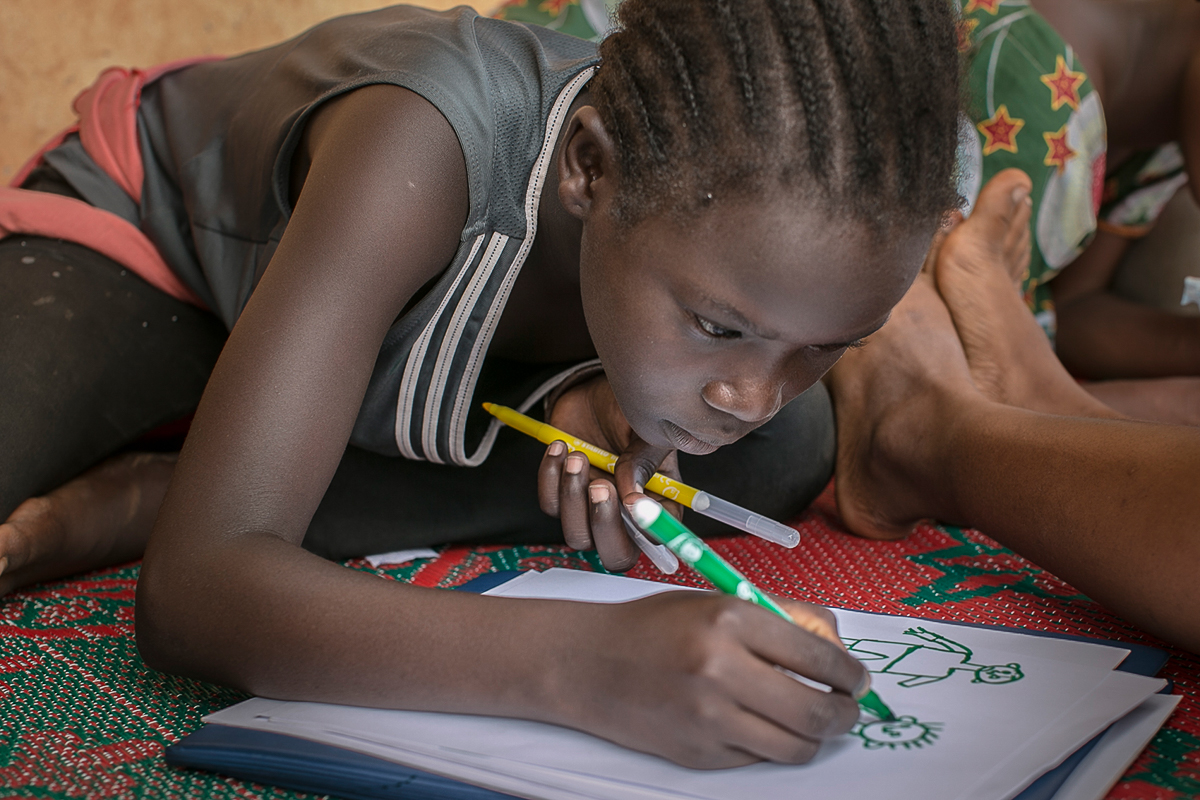
Healing traumatised youngsters in the Central African Republic
Twelve-year-old Anouk concentrates on her drawing. In their last session, the girls were asked to depict happy times – this time they are sketching out their bad memories and trying to reflect their feelings on paper. [Samuel Hauenstein Swan/Al Jazeera]

By Paula Dear and Samuel Hauenstein Swan

Published On 21 Jul 201621 Jul 2016

Share

facebooktwitterwhatsappcopylink

Save

Bangui, Central African Republic – They look like ordinary schoolchildren, sprawled on mats, drawing pictures of their homes and families with felt pens, but the girls’ disturbing images depict scenes of violence – men with guns, missing limbs and lost children.

This class of eight at Gobongo school in Bangui, the capital of the Central African Republic (CAR), is no ordinary lesson, but a group therapy session for children showing symptoms of post-traumatic stress disorder (PTSD), such as aggression, bed-wetting, night terrors, lack of concentration and developmental disorders.

It’s a reality for many in CAR, a country in which every community has been traumatised by a cocktail of brutal conflict, displacement, hunger and poverty.

CAR’s sectarian strife peaked in 2013/14 after a mostly Muslim coalition of fighters, called Seleka, seized power. A coalition of Christian fighters, called anti-balaka, was formed and a cycle of religious and ethnic violence followed, including gun and machete attacks, kidnappings and the burning and looting of homes. More than 6,000 were left dead and nearly one million displaced, according to the UN.

The NGO Action Against Hunger has begun running trauma sessions in an effort to start the healing process, in which children use pictures and role play to describe their symptoms.

Programme coordinator and clinical psychologist Coraline Galliot said many of the children had lost parents and relatives, and had witnessed violence. 

“They can be aggressive and don’t know why. They might be bed-wetting and don’t understand it. They cannot imagine their friends might have the same symptoms, and think they are alone. They often don’t want to share their feelings because of the shame and loss of trust – totally, in everyone.”

Advertisement

The charity has already trained local medical students and teachers, and plans to train 20 additional teachers to help them to identify children with PTSD.

“To defend a feeling of sadness, children often suffer from hyperactivity, which impairs their concentration and can be confused with disobedience,” Galliot explained. “The kid with PTSD might be the most annoying one in the whole class.”

* The names of the children have been changed.

Healing traumatised youngsters in the Central African Republic
The girls are not asked directly what they have experienced. Anouk stands up to describe her picture to the group. She says: 'During the war the guy in the picture had his arm cut off. Someone else has had their house destroyed and they are weeping for it. One person also has a gun and would like to kill someone – he is angry.' [Samuel Hauenstein Swan/Al Jazeera]
Advertisement
Healing traumatised youngsters in the Central African Republic
The group discusses what is happening in a pre-prepared picture story, another tool used by the team's psychosocial workers to help the girls express their feelings. Supervisor Edgar says in the last session, the central character - a hippo - was living on the ground when he should have been in the water. "He seemed alone and sad. This time there are similar themes of PTSD – the hippo is angry and throwing rocks at another animal who has stolen his ball." [Samuel Hauenstein Swan/Al Jazeera]
Healing traumatised youngsters in the Central African Republic
Lucie, 13, adds a gun to the hand of the man she has drawn. Gobongo school teaches pupils from areas of Bangui that are seeing a gradual return of displaced people, who fled violence or had their homes burned down. With 4,000 pupils, class sizes can be as large as 150. [Samuel Hauenstein Swan/Al Jazeera]
Healing traumatised youngsters in the Central African Republic
Lucie holds up the picture she has drawn, showing someone being shot dead while another person looks on. At the top of the picture a man is seen kicking in the door of a house. [Paula Dear/Al Jazeera]
Healing traumatised youngsters in the Central African Republic
A teenager receives an individual counselling session from team member Angel. Some pupils are identified as needing more intensive work because they have more severe symptoms than the others. [Samuel Hauenstein Swan/Al Jazeera]
Healing traumatised youngsters in the Central African Republic
Sylvie, 14, explains her picture to Action Against Hunger's team supervisor Edgar. 'Before the Seleka [arrived] we were in peace and right now we are in anger. That's why I did a picture like this. Everything is broken. There is nothing in our family.' [Samuel Hauenstein Swan/Al Jazeera]
Advertisement
Healing traumatised youngsters in the Central African Republic
Children often display anger or aggression when they are afraid or sad, says psychologist Coralie. 'We talk to them about being in their "safe place". We ask them "What can you see, what colour is in your mind?" Sometimes they cry or do strange things with their bodies, like a kind of trance.' [Paula Dear/Al Jazeera]
Healing traumatised youngsters in the Central African Republic
Emilie, 15, says she can become 'very angry, very easily'. Describing the picture she has drawn, she says: 'The guy is at home but the Seleka want to shoot him. There's a little girl who is not with her parents. She's at the table with her tutors and she feels very depressed.' [Samuel Hauenstein Swan/Al Jazeera]
Healing traumatised youngsters in the Central African Republic
The group draws quietly together, occasionally glancing over at each other's work or reaching for a different coloured pen. Mats have been laid out in the courtyard so that the girls can enjoy some air in the stifling heat. [Samuel Hauenstein Swan/Al Jazeera]
Healing traumatised youngsters in the Central African Republic
'The person in the picture is alone because his whole family was killed in the war and he doesn't know what to do,' says 15-year-old Zoe. [Samuel Hauenstein Swan/Al Jazeera]
Healing traumatised youngsters in the Central African Republic
'During the war the house was broken. They had to leave it because of the struggle. Her father became very angry,' says Mathilde, who is 15. More than 400,000 people are still displaced internally within CAR, while nearly half a million have fled the country. [Samuel Hauenstein Swan/Al Jazeera]
Healing traumatised youngsters in the Central African Republic
The girls enjoy a lighter moment in the session, which they've attended voluntarily despite it being the school holidays. Action Against Hunger – known as Action Contre La Faim (ACF) in CAR – runs trauma sessions in two schools and five neighbourhoods in Bangui. [Samuel Hauenstein Swan/Al Jazeera]
Healing traumatised youngsters in the Central African Republic
Following some energetic exercises, the girls learn to relax with some deep breathing. They hold it for three counts, then breathe out and smile. [Paula Dear/Al Jazeera]
Healing traumatised youngsters in the Central African Republic
The remnants of the morning's work lie on the floor as the session comes to an end. Despite tentative hopes of peace and reconciliation following the election of a new president this year, CAR's situation remains fragile and violence continues to flare. Psychologist Coralie says: 'People feel scared. There is insecurity. Some of it is real, and some is a feeling, a fear. We are working on the feelings.' [Samuel Hauenstein Swan/Al Jazeera]

Related

  • Deadly ‘reprisal attacks’ hit Central African Republic

    At least 10 people killed in rival militias clashes in eastern town of Bambari, as insecurity in CAR persists.

    Published On 8 Mar 20168 Mar 2016
    Bangui CAR
  • UN: Dealing with rape in Central African Republic

    As UN debates for its new secretary general, sex assault by peacekeepers in CAR must be eradicated once and for all.

    Published On 11 Jul 201611 Jul 2016
    CAR - "Operation Sangaris"

More from Gallery

  • Survivors recall terror of landslides from North Sumatra cyclone

    Many survivors are looking for their missing loved ones. Some were carried away by floodwaters, others buried under the mud.
    This gallery article has 14 imagescamera14
  • Photos: Gaza university resumes in-person classes

    Gaza University
    This gallery article has 7 imagescamera7
  • Photos: Pope prays at site of 2020 Beirut port explosion

    Pope Leo XIV visit to Lebanon
    This gallery article has 7 imagescamera7
  • Photos: Recovery under way after floods in Indonesia, Sri Lanka, Thailand

    Rescuers move people to safety on a small boat in a flooded area.
    This gallery article has 8 imagescamera8

Most popular

  • ‘Uninterrupted oil shipments’: Key takeaways from Putin-Modi talks in Delhi

    Russia's President Vladimir Putin and India's Prime Minister Narendra Modi are seen after their talks at Hyderabad House in New Delhi on December 5, 2025 [Alexander Kazakov/Sputnik/Pool via AFP]
  • Infantino’s ‘Peace Prize’ to Trump raises questions about FIFA’s neutrality

    Trump and Infantino
  • FIFA World Cup 2026 draw – updates

    A picture shows groups A, B, C, D, E, F, G, H, I, J, K and L during the draw for the 2026 FIFA Football World Cup taking place in the US, Canada and Mexico, at the Kennedy Center, in Washington, DC, on December 5, 2025. (Photo by Mandel NGAN / POOL / AFP)
  • Pakistan seeks new South Asian bloc to cut India out: Will it work?

    Mohammad Touhid Hossain, foreign affairs adviser of Bangladesh's interim government and Ishaq Dar, Pakistan's foreign minister, attend a bilateral meeting in Dhaka, Bangladesh [File: Bangladesh's Ministry of Foreign Affairs/Handout via Reuters]

  • About

    • About Us
    • Code of Ethics
    • Terms and Conditions
    • EU/EEA Regulatory Notice
    • Privacy Policy
    • Cookie Policy
    • Cookie Preferences
    • Accessibility Statement
    • Sitemap
    • Work for us
  • Connect

    • Contact Us
    • User Accounts Help
    • Advertise with us
    • Stay Connected
    • Newsletters
    • Channel Finder
    • TV Schedule
    • Podcasts
    • Submit a Tip
    • Paid Partner Content
  • Our Channels

    • Al Jazeera Arabic
    • Al Jazeera English
    • Al Jazeera Investigative Unit
    • Al Jazeera Mubasher
    • Al Jazeera Documentary
    • Al Jazeera Balkans
    • AJ+
  • Our Network

    • Al Jazeera Centre for Studies
    • Al Jazeera Media Institute
    • Learn Arabic
    • Al Jazeera Centre for Public Liberties & Human Rights
    • Al Jazeera Forum
    • Al Jazeera Hotel Partners

Follow Al Jazeera English:

  • facebook
  • twitter
  • youtube
  • instagram-colored-outline
  • rss
Al Jazeera Media Network logo
© 2025 Al Jazeera Media Network