Skip linksSkip to Content
The salt farmers of indias rann of kutch marshes - Latest News & Updates
Live
Navigation menu
  • News
    • Africa
    • Asia
    • US & Canada
    • Latin America
    • Europe
    • Asia Pacific
  • Middle East
  • Explained
  • Opinion
  • Sport
  • Video
    • Features
    • Economy
    • Human Rights
    • Climate Crisis
    • Investigations
    • Interactives
    • In Pictures
    • Science & Technology
    • Podcasts
    • Travel
play
Live

In Pictures

Gallery

The salt farmers of India’s Rann of Kutch marshes

The Agariya people brave harsh conditions producing most of India’s salt, but live in poverty and illness as a result.

Work in the fields start in early October, when salt farmers begin the embankment process in the salt flats, still submerged with monsoon water. [Ajay Dhamecha/Al Jazeera]

By Sugato Mukherjee

Published On 18 Sep 201618 Sep 2016

Share

facebooktwitterwhatsappcopylink

Save

Rann of Kutch, Gujarat – Rann of Kutch is a seasonal salt marsh located in the Thar desert  just 10km from the Arabian Sea in India’s Gujarat district. This is the land of the Agariya people, who have lived here for centuries, knowing only one means of livelihood – salt production.

From October to June, they work day in and day out under a fierce sun, harvesting up to 76 percent of the salt produced in India. 

In the monsoon months, Rann of Kutch is submerged in sea water. As the water recedes from October, the Agariyas move in to set up square fields to grow the salt. They dig wells to pump out the briny groundwater and fill the fields where the natural evaporation process leaves behind white crystals.

In winter, the harvest season begins in the salt fields, which are now silvery white with raw salt. Braving a relentless 40 degrees during day time, which often dips to 4 degrees in the desert night, the Agariyas live for six to seven months in the shacks beside their salt flats.

They pay a high price for working in such harsh conditions. According to a study conducted by the National Institute of Occupational Health in Ahmedabad, the farmers suffer from skin lesions, severe eye problems owing to intense reflections off the white surfaces, and tuberculosis. A salt worker of Kutch seldom lives beyond 60 years. 

It is a herculean task to carry the equipment over the marshy tract as no vehicle can negotiate the road in the post-monsoon season. Workers carry everything by hand, including this generator, using a
It is a herculean task to carry the equipment over the marshy tract as no vehicle can negotiate the road in the post-monsoon season. Workers carry everything by hand, including this generator, using a corrugated sheet. [Ajay Dhamecha/Al Jazeera]
Advertisement
Farmers prefer to start the day in the pleasant early morning to avoid the scorching desert heat which soars up to 40C even in December. [Sugato Mukherjee/Al Jazeera]
The salt plains have been converted to a sanctuary for the Wild Ass. The salt farmers were served eviction notices in 2006. The legal limbo continues and the only source of livelihood of the Agariyas
The salt plains have been converted to a sanctuary for the Wild Ass. The salt farmers were served eviction notices in 2006. The legal limbo continues and the only source of livelihood of the Agariyas faces an uncertain future. [Sugato Mukherjee/Al Jazeera]
An Agariya family working in their salt pan in Surajbari creek in Rann of Kutch. Agariya children start working in the salt fields from the age of 10 and do not attend school as a result. [Sugato Mukh
An Agariya family working in their salt pan in Surajbari creek in Rann of Kutch. Agariya children start working in the salt fields from the age of 10 and do not attend school as a result. [Sugato Mukherjee/Al Jazeera]
Surath, 12, has been working in his family''s salt pans for the past two seasons. The only education he has received so far is a few months of primary training in a makeshift school set up by a local N
Surath, 12, has been working in his family''s salt pans for the past two seasons. The only education he has received so far is a few months of primary training in a makeshift school set up by a local NGO at Surajbari. [Sugato Mukherjee/Al Jazeera]
A short tea break during the daily 10-hour schedule, which runs from 7am till 5pm. The salt workers produce an average of 12-15 tonnes of salt every 15 days from each of these salt pans. The salt is s
A short tea break during the daily 10-hour schedule, which runs from 7am till 5pm. The salt workers produce an average of 12-15 tonnes of salt every 15 days from each of these salt pans. The salt is sent to salt companies and chemical factories across the country. [Sugato Mukherjee/Al Jazeera]
Advertisement
Davalram, 64, leveling the salt pan his family has worked on for generations. Most of his friends who started salt farming with him half a century ago, have died. [Sugato Mukherjee/Al Jazeera]
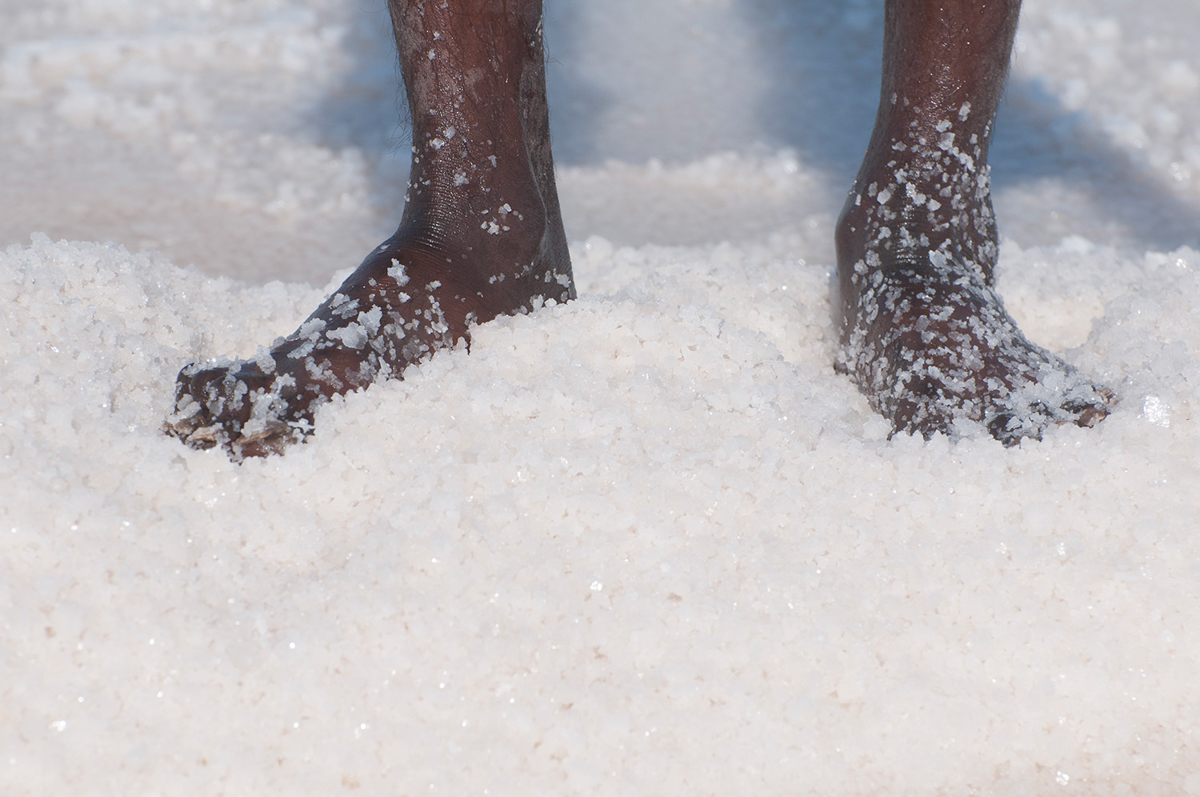
In summer, the temperature is unbearably hot and the salt farmers have to work barefoot, exposing their legs to highly saturated salt. The harvesters earn a paltry sum of 60 Indian rupees per tonne ($
In summer, the temperature is unbearably hot and the salt farmers have to work barefoot, exposing their legs to highly saturated salt. The harvesters earn a paltry sum of 60 Indian rupees per tonne ($1), whereas the market price of industrial salt is 4,000 Indian rupees per tonne ($67). [Sugato Mukherjee/Al Jazeera]
Chhotu, 15, brings water to his family. Rann of Kutch has a scarce supply of drinking water and he must walk 6km to reach the supply. The low income level and lack of education facilities in the barre
Chhotu, 15, brings water to his family. Rann of Kutch has a scarce supply of drinking water and he must walk 6km to reach the supply. The low income level and lack of education facilities in the barren desert offer few opportunities for the children of saltpan workers to escape the cycle of poverty and poor health. Generations of salt workers remain indebted [Sugato Mukherjee/Al Jazeera]
An Agariya woman sorting the grains beside her hut. During the peak harvesting season, the Agariyas set themselves up in makeshift shacks near the salt fields. [Sugato Mukherjee/Al Jazeera]
Children growing up in these salt fields are deprived of education and proper facilities. Lack of education is largely responsible for the cycle of exploitation and poverty the salt farmers face for g
Children growing up in these salt fields are deprived of education and proper facilities. Lack of education is largely responsible for the cycle of exploitation and poverty the salt farmers face for generations. [Sugato Mukherjee/Al Jazeera]
A group of workers at a salt centre from where raw salt is transported to the local salt factories. [Ajay Dhamecha/Al Jazeera]
Agariya women and children work in local salt factories. The pay for packing 1,000 packets of salt is as low as 80 Indian rupees ($1.30). [Sugato Mukherjee/Al Jazeera]
Another day begins in the salt plains of Kutch, which produces 76 percent of India’s total salt production. [Sugato Mukherjee/Al Jazeera]

Related

  • A passage of hope on India’s hospital train

    Medical specialists travel across the country to deliver healthcare to the underprivileged.

    Published On 28 Jul 201628 Jul 2016
    Hospital Train/ Please Do Not Use
    This gallery article has 10 imagescamera10
  • Hindus perform annual ceremony on erupting Mount Bromo

    An erupting volcano has not prevented Indonesia’s Tenggerese people from performing their annual ceremony.

    Published On 24 Jul 201624 Jul 2016
    Traditional Hindu Festival
    This gallery article has 12 imagescamera12

More from Gallery

  • Survivors recall terror of landslides from North Sumatra cyclone

    Many survivors are looking for their missing loved ones. Some were carried away by floodwaters, others buried under the mud.
    This gallery article has 14 imagescamera14
  • Photos: Gaza university resumes in-person classes

    Gaza University
    This gallery article has 7 imagescamera7
  • Photos: Pope prays at site of 2020 Beirut port explosion

    Pope Leo XIV visit to Lebanon
    This gallery article has 7 imagescamera7
  • Photos: Recovery under way after floods in Indonesia, Sri Lanka, Thailand

    Rescuers move people to safety on a small boat in a flooded area.
    This gallery article has 8 imagescamera8

Most popular

  • ‘Uninterrupted oil shipments’: Key takeaways from Putin-Modi talks in Delhi

    Russia's President Vladimir Putin and India's Prime Minister Narendra Modi are seen after their talks at Hyderabad House in New Delhi on December 5, 2025 [Alexander Kazakov/Sputnik/Pool via AFP]
  • Infantino’s ‘Peace Prize’ to Trump raises questions about FIFA’s neutrality

    Trump and Infantino
  • FIFA World Cup 2026 draw – updates

    A picture shows groups A, B, C, D, E, F, G, H, I, J, K and L during the draw for the 2026 FIFA Football World Cup taking place in the US, Canada and Mexico, at the Kennedy Center, in Washington, DC, on December 5, 2025. (Photo by Mandel NGAN / POOL / AFP)
  • MF Husain was forced into exile; now his work finds permanent home in Qatar

    A picture of MF Husain at Lawh Wa Qalam: M. F. Husain Museum, Doha, Qatar.

  • About

    • About Us
    • Code of Ethics
    • Terms and Conditions
    • EU/EEA Regulatory Notice
    • Privacy Policy
    • Cookie Policy
    • Cookie Preferences
    • Accessibility Statement
    • Sitemap
    • Work for us
  • Connect

    • Contact Us
    • User Accounts Help
    • Advertise with us
    • Stay Connected
    • Newsletters
    • Channel Finder
    • TV Schedule
    • Podcasts
    • Submit a Tip
    • Paid Partner Content
  • Our Channels

    • Al Jazeera Arabic
    • Al Jazeera English
    • Al Jazeera Investigative Unit
    • Al Jazeera Mubasher
    • Al Jazeera Documentary
    • Al Jazeera Balkans
    • AJ+
  • Our Network

    • Al Jazeera Centre for Studies
    • Al Jazeera Media Institute
    • Learn Arabic
    • Al Jazeera Centre for Public Liberties & Human Rights
    • Al Jazeera Forum
    • Al Jazeera Hotel Partners

Follow Al Jazeera English:

  • facebook
  • twitter
  • youtube
  • instagram-colored-outline
  • rss
Al Jazeera Media Network logo
© 2025 Al Jazeera Media Network