Skip linksSkip to Content
An unknown migrant route into eu runs through lithuania - Latest News & Updates
Live
Navigation menu
  • News
    • Africa
    • Asia
    • US & Canada
    • Latin America
    • Europe
    • Asia Pacific
  • Middle East
  • Explained
  • Opinion
  • Sport
  • Video
    • Features
    • Economy
    • Human Rights
    • Climate Crisis
    • Investigations
    • Interactives
    • In Pictures
    • Science & Technology
    • Podcasts
    • Travel
play
Live

In Pictures

Gallery|Poverty and Development

An unknown migrant route into EU runs through Lithuania

A newly discovered route through Lithuania’s eastern border opens gateway into Western Europe for migrants and refugees.
An unknown migrant route into the EU runs through Lithuania / Please Do Not Use
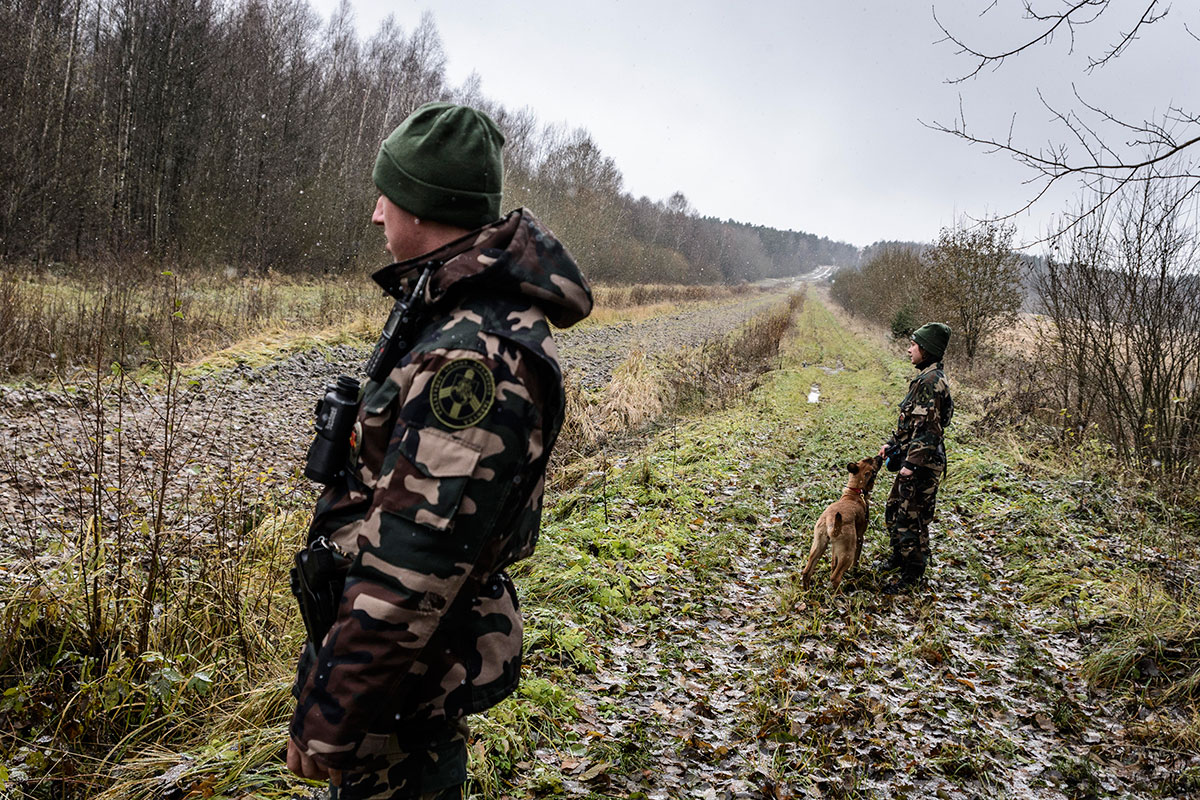
Border guards Rafal and Egle respond to a seismic alarm on the Belarusian-Lithuanian border. They scout the area to determine the cause for the alarm. In this case, it was most likely caused by a migrating animal. [Benas Gerdziunas/Al Jazeera]

By Benas Gerdziunas

Published On 10 Jan 201710 Jan 2017

Share

facebooktwitterwhatsappcopylink

Save

Pabrade, Lithuania – North of the Mediterranean and Balkan routes to Europe, some migrants and refugees have discovered an unknown route into the European Union through Lithuania’s eastern borders. Despite Lithuanian border guards’ efforts, criminal organisations continue to smuggle migrants from Belarus into Europe.

Lithuania – the Baltic nation of three million people – is situated between Russian exclave Kaliningrad, Belarus, Poland and Latvia, making it a geographically convenient gateway to Western Europe.

“The transit route through Lithuania has been used for many years,” says Renatas Pozela, commander of the Lithuanian State Border Guard Service. “We are also seeing constant attempts to open new corridors [to Europe], mostly by Syrian and Iraqi refugees who are trying to reach Scandinavian countries.”

The new phenomenon in recent years has seen hundreds of Vietnamese migrants attempting to cross into the European Union. This was exacerbated by the economic crisis in Russia, according to Pozela, where most of these Vietnamese had previously worked. Their Chechen smugglers are alleged to have links with organised crime and Russia’s Federal Security Service (FSB).

According to national security assessment published in June 2016 by Lithuania’s State Security Department, “FSB seeks to recruit persons who organise smuggling activities and transportation of smuggled goods.”

Although border authorities in all three Baltic states have been able to arrest low-level members of smuggling rings, “the leaders of these criminal organisations are from [the] Russian Federation”, Pozela told Al Jazeera. “For various reasons, they’re unreachable by our justice system.”

Advertisement

Inside the migrant registration centre in the eastern Lithuanian town of Pabrade, Vietnamese migrants live separated from other detainees and their Chechen smugglers.

“We are trying to prevent prison rules being brought into the centre, as well as limit conflicts arising from cultural differences,” says Aleksandras Kislovas – head of the centre.

Nearby, a separate block houses asylum seekers, mostly from the Middle East and Afghanistan. While their applications are being considered, asylum seekers are free to leave the centre for up to 72 hours.

Laying out a stack of black-and-white photographs, Kislovas shows the first inhabitants in the centre, which was refurbished and converted from a Soviet military base in the early 1990s.

“Humanity has been migrating since the beginning of time,” Kislovas says. “It will not stop trying to find the best place in the world.”

Additional reporting by Jonathan Brown @Jonathaneebrown

An unknown migrant route into the EU runs through Lithuania / Please Do Not Use
A nearly abandoned village on the Belarusian-Lithuanian border. The Dieveniskes region has seen many residents move to urban centres in the past 10 years - a trend common to other Baltic states and elsewhere in Eastern Europe. [Benas Gerdziunas/Al Jazeera]
Advertisement
An unknown migrant route into the EU runs through Lithuania / Please Do Not Use
Border guard Linas Taskunas looks for footprints on the Belarusian-Lithuanian border in a spot often used by the smugglers. On the hill above it, spotters regularly observe the border guards' movements to coordinate the contraband 'throw-over' operations. [Benas Gerdziunas/Al Jazeera]
An unknown migrant route into the EU runs through Lithuania / Please Do Not Use
Vietnamese detainees in the Pabrade Foreigners' Registration Centre. Officers often spot criminal elements among those detained, judging by the tattoos - although this is more prevalent among those from Russia. [Benas Gerdziunas/Al Jazeera]
An unknown migrant route into the EU runs through Lithuania / Please Do Not Use
Vietnamese migrants are separated from the other groups to avoid conflicts arising from cultural differences. 'We also eliminate all the possible prison rules being brought into the centre,' explained Aleksandras Kislovas. [Benas Gerdziunas/Al Jazeera]
An unknown migrant route into the EU runs through Lithuania / Please Do Not Use
Egle is one of the newest recruits in the force. 'The only way women can be effective is with dogs. Look at me, what could I do without a dog?' she smiles. [Benas Gerdziunas/Al Jazeera]
An unknown migrant route into the EU runs through Lithuania / Please Do Not Use
Two border guards inspect rubbish left behind by the 'spotters' - youths from the region who spot the border guards' movements and report to other contraband smugglers. [Benas Gerdziunas/Al Jazeera]
Advertisement
An unknown migrant route into the EU runs through Lithuania / Please Do Not Use
Taskunas pulls over a lone car close to midnight. After checking the documents and interior of the car, he comes back. 'He is a well-known [cigarettes] smuggler to us but has nothing this time,' Linas motions. [Benas Gerdziunas/Al Jazeera]
An unknown migrant route into the EU runs through Lithuania / Please Do Not Use
Zydrunas Vaikasas outlines the border zone of Dieveniskes Noose. Zydrunas stood at the barricades during the independence fights in 1991 and was one of the first people to join the border guards, who were then under military jurisdiction. The massacres of Medininkai took place during this time, when seven border guards were killed by Russian police special forces. The border guards' post is named after Gintaras Zagunys - the first border guard killed after independence in 1991. [Benas Gerdziunas/Al Jazeera]
An unknown migrant route into the EU runs through Lithuania / Please Do Not Use
Inside the locker room of the border guards. They work in two shifts - 15-hour night shifts and 12-hour day shifts, which overlap. 'Sometimes, we spend the whole 15 hours patrolling the border on foot,' says Linas, 'sometimes with a rifle in hand - if ordered by the commander.' [Benas Gerdziunas/Al Jazeera]
An unknown migrant route into the EU runs through Lithuania / Please Do Not Use
Border guard Algirdas opens the gates into the detention centre in Pabrade, which is separated from the asylum seekers' housing. [Benas Gerdziunas/Al Jazeera]
An unknown migrant route into the EU runs through Lithuania / Please Do Not Use
Women detainees are separated from men and families. Here, a Vietnamese woman makes a phone call home. [Benas Gerdziunas/Al Jazeera]
An unknown migrant route into the EU runs through Lithuania / Please Do Not Use
Gym inside the detention centre in Pabrade. 'We organise various tournaments to keep them occupied,' says Aleksandras Kislovas, head of the centre. 'We recognised that social activities are the most important thing to keep everyone content.' On the wall, cryptic Vietnamese graffiti reads: 'If people don't write on the walls, you get kept in prison by the communists.' [Benas Gerdziunas/Al Jazeera]
An unknown migrant route into the EU runs through Lithuania / Please Do Not Use
Border guard Linas Taskunas arrives at the staging point before embarking on a foot patrol along the Belarusian-Lithuanian demarcation line. The border guards work in two 12 and 15-hour overlapping shifts to decrease smugglers' chances of catching them off-guard. [Benas Gerdziunas/Al Jazeera]

Related

  • Desperate journeys: Lending a helping ship

    A private initiative patrols the Mediterranean waters every day, rescuing stranded refugees.

    Published On 25 Aug 201625 Aug 2016
    On Strange Waters/ Please Do Not Use
    This gallery article has 11 imagescamera11
  • Rescued migrants recall desperate journeys to Europe

    Al Jazeera speaks to a number of migrants rescued from boats in the Mediterranean.

    Published On 5 Jun 20155 Jun 2015
    Mediterranean rescues

More from Gallery

  • Survivors recall terror of landslides from North Sumatra cyclone

    Many survivors are looking for their missing loved ones. Some were carried away by floodwaters, others buried under the mud.
    This gallery article has 14 imagescamera14
  • Photos: Gaza university resumes in-person classes

    Gaza University
    This gallery article has 7 imagescamera7
  • Photos: Pope prays at site of 2020 Beirut port explosion

    Pope Leo XIV visit to Lebanon
    This gallery article has 7 imagescamera7
  • Photos: Recovery under way after floods in Indonesia, Sri Lanka, Thailand

    Rescuers move people to safety on a small boat in a flooded area.
    This gallery article has 8 imagescamera8

Most popular

  • ‘Uninterrupted oil shipments’: Key takeaways from Putin-Modi talks in Delhi

    Russia's President Vladimir Putin and India's Prime Minister Narendra Modi are seen after their talks at Hyderabad House in New Delhi on December 5, 2025 [Alexander Kazakov/Sputnik/Pool via AFP]
  • Infantino’s ‘Peace Prize’ to Trump raises questions about FIFA’s neutrality

    Trump and Infantino
  • FIFA World Cup 2026 draw – updates

    A picture shows groups A, B, C, D, E, F, G, H, I, J, K and L during the draw for the 2026 FIFA Football World Cup taking place in the US, Canada and Mexico, at the Kennedy Center, in Washington, DC, on December 5, 2025. (Photo by Mandel NGAN / POOL / AFP)
  • MF Husain was forced into exile; now his work finds permanent home in Qatar

    A picture of MF Husain at Lawh Wa Qalam: M. F. Husain Museum, Doha, Qatar.

  • About

    • About Us
    • Code of Ethics
    • Terms and Conditions
    • EU/EEA Regulatory Notice
    • Privacy Policy
    • Cookie Policy
    • Cookie Preferences
    • Accessibility Statement
    • Sitemap
    • Work for us
  • Connect

    • Contact Us
    • User Accounts Help
    • Advertise with us
    • Stay Connected
    • Newsletters
    • Channel Finder
    • TV Schedule
    • Podcasts
    • Submit a Tip
    • Paid Partner Content
  • Our Channels

    • Al Jazeera Arabic
    • Al Jazeera English
    • Al Jazeera Investigative Unit
    • Al Jazeera Mubasher
    • Al Jazeera Documentary
    • Al Jazeera Balkans
    • AJ+
  • Our Network

    • Al Jazeera Centre for Studies
    • Al Jazeera Media Institute
    • Learn Arabic
    • Al Jazeera Centre for Public Liberties & Human Rights
    • Al Jazeera Forum
    • Al Jazeera Hotel Partners

Follow Al Jazeera English:

  • facebook
  • twitter
  • youtube
  • instagram-colored-outline
  • rss
Al Jazeera Media Network logo
© 2025 Al Jazeera Media Network