Skip linksSkip to Content
Kenyas maasai and samburu becoming women without fgm - Latest News & Updates
Live
Navigation menu
  • News
    • Africa
    • Asia
    • US & Canada
    • Latin America
    • Europe
    • Asia Pacific
  • Middle East
  • Explained
  • Opinion
  • Sport
  • Video
    • Features
    • Economy
    • Human Rights
    • Climate Crisis
    • Investigations
    • Interactives
    • In Pictures
    • Science & Technology
    • Podcasts
    • Travel
play
Live

In Pictures

Gallery|Women

Kenya’s Maasai and Samburu becoming women without FGM

‘When my parents called the [cutter for my sister], I warned the district officer. Our generation can bring change.’
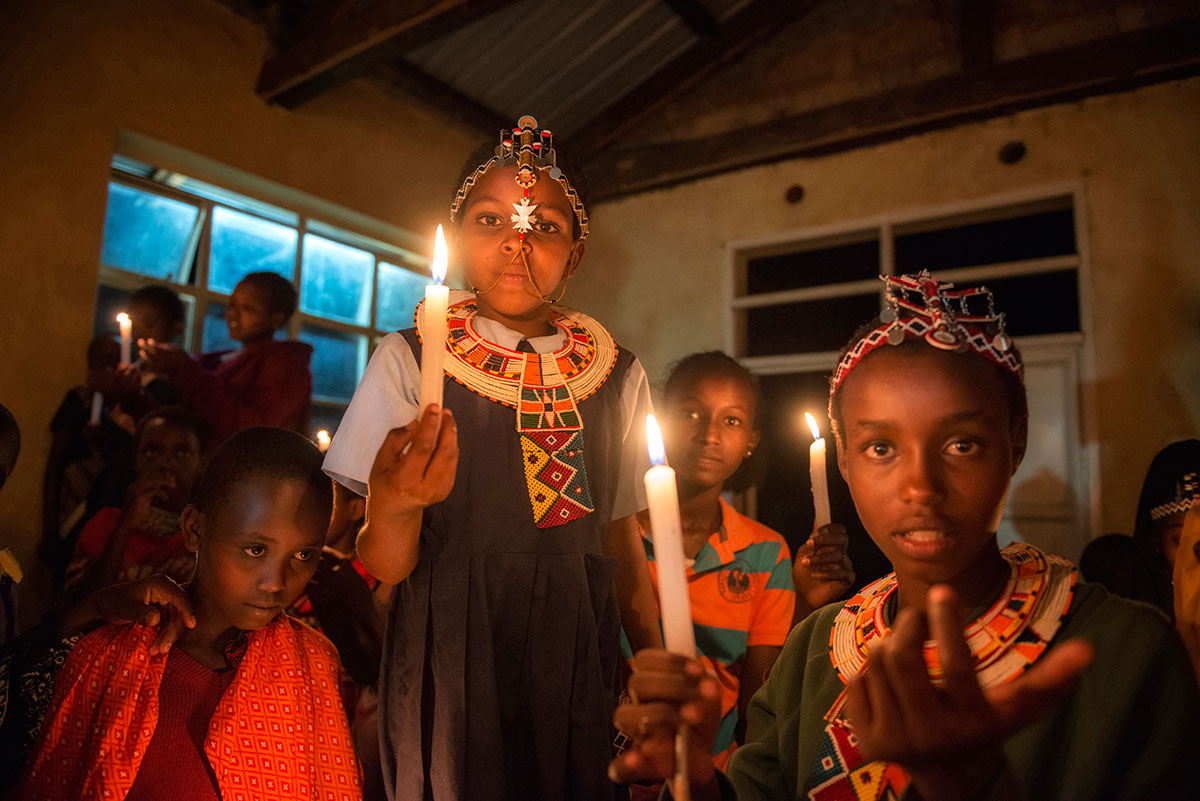
Becoming a woman without ‘the cut’ / Please DO Not Use
Maasai girls during the Candle Light Ceremony, an important part of the Alternative Rite of Passage programme, that symbolises the girls' entering womanhood and shaping their own destiny through education and informed personal decisions. [Jeroen Van Loon/Al Jazeera]

By Andrea Dijkstra and Jeroen Van Loon

Published On 6 Feb 20176 Feb 2017

Share

facebooktwitterwhatsappcopylink

Save

Magadi, Kenya – Girls in colourful dresses dance and sing while holding candles that light up their smiling faces.

“Extinguish the light of [FGM]. Kindle the light of education,” they sing as they lift their candles. These girls of a Maasai community in Magadi, southern Kenya, are entering their adult lives through a new ceremony designed to abandon a tradition that has injured so many before.

Although female genital mutilation (FGM) has been outlawed in Kenya since 2001, a majority of girls of semi-nomadic tribes like the Maasai and Samburu still undergo this painful and damaging ritual.

According to the Kenya Demographic Household Survey of 2014, some 78 percent of Maasai women and 86 percent of Samburu women between the ages of 15 and 49, have been mutilated, while for Kenya’s general population the figure for FGM stands at 21 percent.


READ MORE – Senegal: Breaking the cycle of FGM


Nine years ago, the NGO Amref Health Africa started training peer trainers among all age groups in Maasai and Samburu communities – elders, young men, mothers, and young girls – on the consequences of FGM. Together with several communities, the organisation developed the strategy called an Alternative Rite of Passage and now already more than 13,300 Maasai and Samburu girls have avoided FGM.

“In the beginning we faced a lot of resistance,” Peter Nguura, project manager of Amref Health Africa, told Al Jazeera.

“But step by step, and starting with the engagement of the cultural elders as the key decision makers in the communities, we managed to create a conducive atmosphere of trust and confidence to discuss these culturally sensitive issues and meaningful and fruitful dialogue is now going on led by the community leaders themselves.”

Advertisement

Alice, 63, did not want to be part of the training in the beginning. She, as a traditional cutter, was proud to be the one to help girls to become a woman. “‘Who are you to change our culture?’ were my first thoughts,” she told Al Jazeera.

“But I changed my mind after I learned that FGM can cause serious medical problems that can even be life threatening.”

Becoming a woman without ‘the cut’ / Please DO Not Use
Young Maasai men show their strength by jumping as high as possible. This important Maasai tradition is also part of the Alternative Rite of Passage that encourages communities to maintain their cultural ceremonies and rites surrounding female initiation while abandoning the genital mutilation practice. [Jeroen Van Loon/Al Jazeera]
Advertisement
Becoming a woman without ‘the cut’ / Please DO Not Use
Peter Nguura, left, project manager of Amref Health Africa, teaches the whole community about how FGM causes serious medical problems, including excessive bleeding, urinary tract infections and complications during childbirth. [Jeroen Van Loon/Al Jazeera]
Becoming a woman without ‘the cut’ / Please DO Not Use
The whole community takes part in the Alternative Rite of Passage ceremony. 'The communities themselves are driving the change,' says Peter Nguura, project manager of Amref Health Africa. 'This makes it sustainable and guarantees that the change will continue even after support of donors and Amref Health Africa will stop.' [Jeroen Van Loon/Al Jazeera]
Becoming a woman without ‘the cut’ / Please DO Not Use
Maasai community members hold banners with messages, such as 'We are against early marriage'. In the past, most Maasai and Samburu girls were married while still children, soon after being mutilated upon reaching puberty, and often dropped out of school as a result. [Jeroen Van Loon/Al Jazeera]
Becoming a woman without ‘the cut’ / Please DO Not Use
During the Alternative Rite of Passage ceremony, Maasai elders give girls a book and a pen to encourage them to continue their education. By accepting a blanket, given by the girls, the cultural leaders pledge that they will neither accept the mutilation of the girls, nor early marriage. [Jeroen Van Loon/Al Jazeera]
Becoming a woman without ‘the cut’ / Please DO Not Use
Young Samburu warriors in Wamba, Central Kenya, are known as 'morans'. They play a crucial role in the Alternative Rite of Passage ceremonies, as they are the prospective husbands and promise to marry the uncircumcised girls. 'They are very influential, so without their approval, we wouldn't succeed,' says Peter Nguura, project manager of Amref Health Africa. [Jeroen Van Loon/Al Jazeera]
Advertisement
Becoming a woman without ‘the cut’ / Please DO Not Use
Maasai girls dress up for the beauty contest, another part of the Alternative Rite of Passage ceremony in Magadi, Southern Kenya. 'It encourages the girls to stand up independently and shine by boosting their self-esteem,' says Peter Nguura. [Jeroen Van Loon/Al Jazeera]
Becoming a woman without ‘the cut’ / Please DO Not Use
'I prevented the [mutilation] of my sister,” 16-year-old Joseph proudly says while standing in front of the classroom, next to his sister, left, and Peter Nguura, right, from Amref Health Africa, at the Musenke Primary School in Magadi, Kenya. 'When my parents called the [cutter], I warned the district officer who interfered. Our generation can bring change.' [Jeroen Van Loon/Al Jazeera]
Becoming a woman without ‘the cut’ / Please DO Not Use
Older Samburu women dance during an Alternative Rite of Passage ceremony in Wamba, central Kenya. Not everyone completely agrees to abandon FGM. Some grandparents worry that their granddaughters will never find a man to marry. Others believe that abandoning FGM will bring misfortune and that the father of a child of an uncut woman will die. [Jeroen Van Loon/Al Jazeera]
Becoming a woman without ‘the cut’ / Please DO Not Use
Maasai girl, Emaculate, 16, is thrilled to participate in the Alternative Rite of Passage ceremony in Magadi. 'Now I can finish my school,' she says. 'I want to become a politician to stand up for the rights of other people.' [Jeroen Van Loon/Al Jazeera]

Related

  • From: The Stream

    Why gender-based violence in South Africa is now a national emergency

    We look back at South Africa’s nationwide shutdown by women, as they halted work to protest gender-based violence.

    Published On 28 Nov 202528 Nov 2025
    Video Duration 25 minutes 20 seconds play-arrow25:20
  • Photos: Protesters worldwide demand end to violence against women

    The UN finds home most dangerous place for women, with about 50,000 of them killed by partners or family last year.

    Published On 26 Nov 202526 Nov 2025
    Women take part in a demonstration on the International Day for the Elimination of Violence against Women in Guatemala City,
    This gallery article has 7 imagescamera7
  • Italy adds ‘femicide’ to the criminal code to curb violence against women

    Italian Prime Minister Giorgia Meloni has supported a bill to punish ‘femicide’ with life imprisonment.

    Published On 26 Nov 202526 Nov 2025
    Women hold banners reading 'You are healthy children of patriarchy' and 'Femicide is a state murder, the state does not protect us' during a gathering for the International Day for the Elimination of Violence Against Women in Milan, Italy, on November 25, 2023 [Luca Bruno/AP Photo]
  • How a study on hormonal contraception and breast cancer was distorted

    Swedish study says hormonal birth control slightly raises breast cancer risk, but experts note the increase is small.

    Published On 25 Nov 202525 Nov 2025
    A one-month dosage of hormonal birth control pills is displayed in Sacramento, California. [File: Rich Pedroncelli/AP Photo]

More from Gallery

  • Survivors recall terror of landslides from North Sumatra cyclone

    Many survivors are looking for their missing loved ones. Some were carried away by floodwaters, others buried under the mud.
    This gallery article has 14 imagescamera14
  • Photos: Gaza university resumes in-person classes

    Gaza University
    This gallery article has 7 imagescamera7
  • Photos: Pope prays at site of 2020 Beirut port explosion

    Pope Leo XIV visit to Lebanon
    This gallery article has 7 imagescamera7
  • Photos: Recovery under way after floods in Indonesia, Sri Lanka, Thailand

    Rescuers move people to safety on a small boat in a flooded area.
    This gallery article has 8 imagescamera8

Most popular

  • Infantino’s ‘Peace Prize’ to Trump raises questions about FIFA’s neutrality

    Trump and Infantino
  • FIFA World Cup 2026 draw – updates

    A picture shows groups A, B, C, D, E, F, G, H, I, J, K and L during the draw for the 2026 FIFA Football World Cup taking place in the US, Canada and Mexico, at the Kennedy Center, in Washington, DC, on December 5, 2025. (Photo by Mandel NGAN / POOL / AFP)
  • Arab, Muslim nations reject Israel exit-only plan for Gaza Rafah crossing

    Rafah crossing, Gaza
  • ‘Uninterrupted oil shipments’: Key takeaways from Putin-Modi talks in Delhi

    Russia's President Vladimir Putin and India's Prime Minister Narendra Modi are seen after their talks at Hyderabad House in New Delhi on December 5, 2025 [Alexander Kazakov/Sputnik/Pool via AFP]

  • About

    • About Us
    • Code of Ethics
    • Terms and Conditions
    • EU/EEA Regulatory Notice
    • Privacy Policy
    • Cookie Policy
    • Cookie Preferences
    • Accessibility Statement
    • Sitemap
    • Work for us
  • Connect

    • Contact Us
    • User Accounts Help
    • Advertise with us
    • Stay Connected
    • Newsletters
    • Channel Finder
    • TV Schedule
    • Podcasts
    • Submit a Tip
    • Paid Partner Content
  • Our Channels

    • Al Jazeera Arabic
    • Al Jazeera English
    • Al Jazeera Investigative Unit
    • Al Jazeera Mubasher
    • Al Jazeera Documentary
    • Al Jazeera Balkans
    • AJ+
  • Our Network

    • Al Jazeera Centre for Studies
    • Al Jazeera Media Institute
    • Learn Arabic
    • Al Jazeera Centre for Public Liberties & Human Rights
    • Al Jazeera Forum
    • Al Jazeera Hotel Partners

Follow Al Jazeera English:

  • facebook
  • twitter
  • youtube
  • instagram-colored-outline
  • rss
Al Jazeera Media Network logo
© 2025 Al Jazeera Media Network