Skip linksSkip to Content
Hardship and political theatre the crisis in venezuela - Latest News & Updates
Live
Navigation menu
  • News
    • Africa
    • Asia
    • US & Canada
    • Latin America
    • Europe
    • Asia Pacific
  • Middle East
  • Explained
  • Opinion
  • Sport
  • Video
    • Features
    • Economy
    • Human Rights
    • Climate Crisis
    • Investigations
    • Interactives
    • In Pictures
    • Science & Technology
    • Podcasts
    • Travel
play
Live

In Pictures

Gallery|Poverty and Development

Hardship and political theatre: The crisis in Venezuela

Photographer Wil Riera documents people’s struggles and the theatre of street politics in his native Venezuela.

Venezuela’s No Bread and Circus/ Please Do Not Use
Venezuela's President Nicolas Maduro speaks during a pro-government rally in Caracas on June 26, 2015. Maduro's approval ratings have fallen as the country faces an economic crisis and three-digit inflation. [Wil Riera/Al Jazeera]

By Wil Riera

Published On 2 Apr 20172 Apr 2017

Share

facebooktwitterwhatsappcopylink

Save

Caracas, Venezuela – At 34, I’ve spent almost half of my life under the same government.

One morning in 1992, when I was ten, my mother didn’t wake me up for elementary school. Hours later, when I got up, the streets were empty. There had been an attempted coup; my parents, like others, were in a state of shock.  

That day I heard Hugo Chavez’s name for the first time. He was speaking on television, wearing his signature red beret, as the military leader of a failed coup against the former president Carlos Andres Perez.

Seven years later, Chavez became Venezuela’s president through elections, winning an overwhelming majority of the votes, and the country began its transition into “21st-century socialism”, leveraging oil wealth into social programmes for education and housing to help poor communities.

Venezuela, however, was politically divided. My family gatherings grew smaller as Chavistas – Chavez’s supporters – and opposition supporters stopped talking to each other. Within my own immediate family, my father supported Chavez while my mother and brother supported the opposition; they were adamant that a former military officer couldn’t solve our country’s problems.

Following Chavez’s death in 2013, Nicolas Maduro – his close political ally – became president after winning the election. Maduro is not as charismatic or popular as the former president. Under his leadership, the military presence in government offices has grown. And Venezuela has lapsed into an economic, political and social crisis. 

Advertisement

Oil-exporting Venezuela became dependent on food imports, but when the price of oil collapsed in 2014, the government could no longer afford the food and medicines that the country needed.

Shortages have become commonplace and basic goods are rationed. According to the last digit of one’s ID card, people are assigned a day in the week to buy groceries – just one or two items of the same product – at subsidised prices.

Crime and violence are also widespread. In 2016, 27,479 people were killed – an all-time high – according to the independent group the Venezuelan Violence Observatory.

The crackdown against Maduro’s political opponents has intensified. Opponents have been jailed, accused of or charged with trying to overthrow the government. 

At the end of 2014, I began a long-term project to document the Venezuelan people’s struggles, frustrations and spirit at a time of crisis. I also wanted to document the theatrical practices of the political forces – those in power and in opposition – in holding regular political rallies and free concerts and disseminating propaganda. These have become like a national sport; a distraction from the daily hardships.

Having witnessed the crisis first-hand, I also aim to show how, no matter which political ideology people identify with, we all seek change and hope for a better future.

Venezuela’s No Bread and Circus/ Please Do Not Use
An opposition supporter waves a party flag at the end of the campaign for the National Assembly elections in Caracas on December 2, 2015. [Wil Riera/Al Jazeera]
Advertisement
Venezuela’s No Bread and Circus/ Please Do Not Use
A mobile truck serving fast food in Caracas offers a delivery service so customers can avoid being kidnapped. The banner reads: "Deliver. Do not expose yourself, you can pay for food via wire transfer" while President Maduro and his wife Cilia Flores appear on TV on December 6, 2015, the day of the legislative elections. [Wil Riera/Al Jazeera]
Venezuela’s No Bread and Circus/ Please Do Not Use
Voters in the Petare slum in Caracas line up outside a polling station for the December 6, 2015 legislative elections. On the public school wall is a mural of the former Venezuelan president Hugo Chavez. [Wil Riera/Al Jazeera]
Venezuela’s No Bread and Circus/ Please Do Not Use
Humberto Lopez, known as 'El Che', poses while sitting in his truck in Caracas. Cuba strongly influences the Venezuelan government and their political, economic and social strategies. January 23, 2015. [Wil Riera/Al Jazeera]
Venezuela’s No Bread and Circus/ Please Do Not Use
A man displays his arm with a number to mark his position in a queue to buy toilet paper and rice at a supermarket in Caracas on November 24, 2014. People have to wait for up to three hours to buy cost-regulated basics. [Wil Riera/Al Jazeera]
Venezuela’s No Bread and Circus/ Please Do Not Use
Bare shelves inside a rural house in El Hatillo on March 18, 2017. Rural areas in the country have been hard hit by the basic food shortages. [Wil Riera/Al Jazeera]
Advertisement
Venezuela’s No Bread and Circus/ Please Do Not Use
A grocery store owner inspects his premises in San Felix, Bolivar State, on July 8, 2015, after it was looted by people looking for basic goods. [Wil Riera/Al Jazeera]
Venezuela’s No Bread and Circus/ Please Do Not Use
A child carries an empty gas canister in order to buy a new one from state oil company workers in the Petare slum, Caracas on March 10, 2017. [Wil Riera/Al Jazeera]
Venezuela’s No Bread and Circus/ Please Do Not Use
Children play in a 23 de Enero slum playground in Caracas, close to the Cuartel de la Montana barracks, where the tomb of the former president Hugo Chavez is located. March 5, 2015. [Wil Riera/Al Jazeera]
Venezuela’s No Bread and Circus/ Please Do Not Use
A effigy of President Maduro is set alight during the traditional Easter celebration 'Burning of the Judas' as a part of protests against the government in Caracas on March 26, 2016. [Wil Riera/Al Jazeera]
Venezuela’s No Bread and Circus/ Please Do Not Use
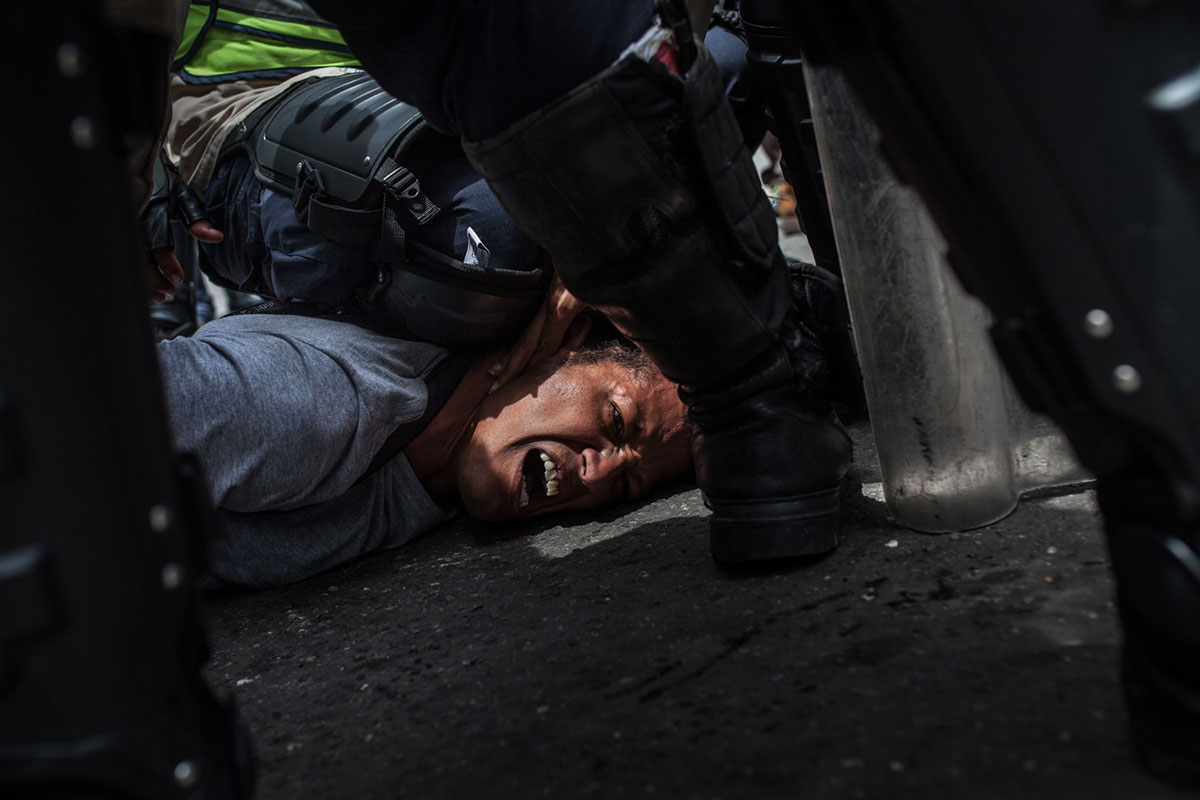
Police detain a demonstrator during a protest against Venezuelan president Nicolas Maduro's government in Caracas on May 18, 2016. [Wil Riera/Al Jazeera]
Venezuela’s No Bread and Circus/ Please Do Not Use
Police officers react to tear gas at a protest against President Maduro in Caracas on May 18, 2016. [Wil Riera/Al Jazeera]
Venezuela’s No Bread and Circus/ Please Do Not Use
Protesters clash with police during a demonstration in support of a referendum on the rule of President Maduro in Caracas on July 26, 2016. [Wil Riera/Al Jazeera]
Venezuela’s No Bread and Circus/ Please Do Not Use
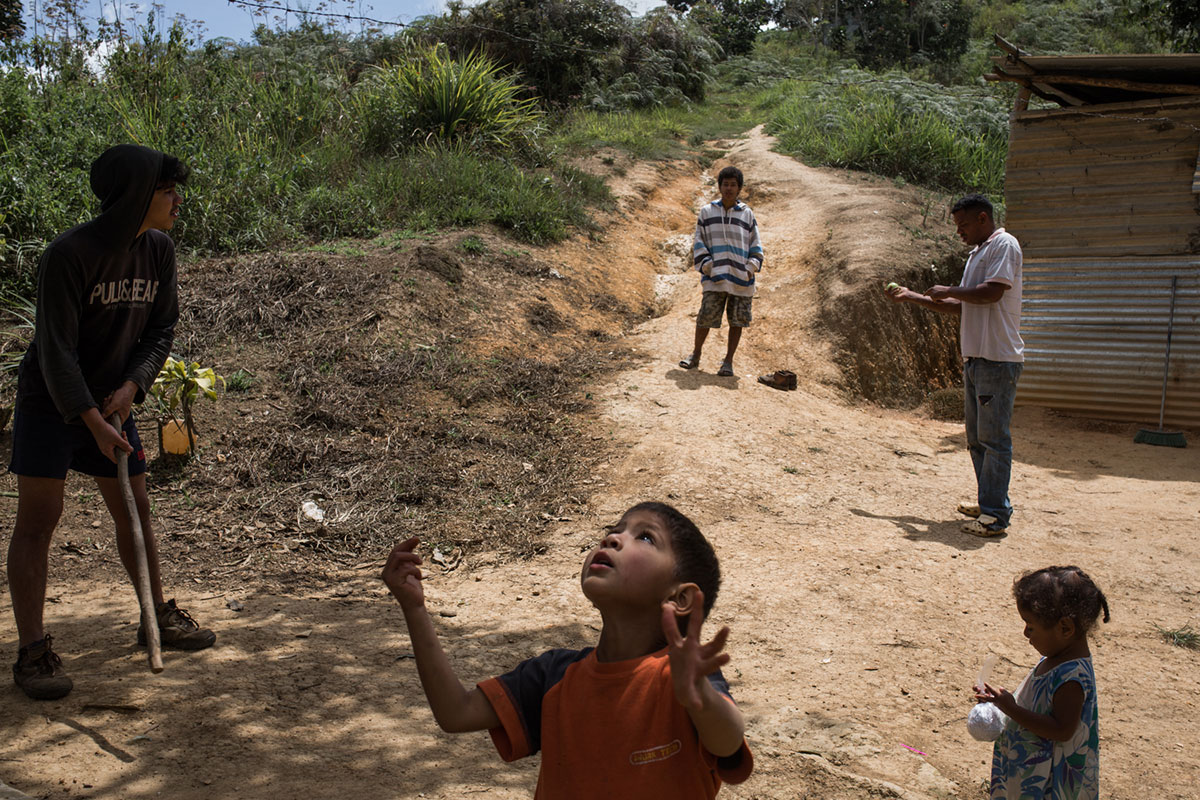
Family members play baseball outside a rural house in El Hatillo, one the five municipalities of Caracas, on March 18, 2017. Rural areas have been hard hit by the country's chronic shortages. [Wil Riera/Al Jazeera]

Related

  • The face of hunger and malnutrition in Venezuela

    Inflation and food shortages leave Venezuelans trapped in food queues or at the mercy of food smugglers.

    Published On 10 Oct 201610 Oct 2016
    Hunger in Venezuela / Please Do Not Use
    This gallery article has 14 imagescamera14
  • Venezuelans flock across border due to food shortage

    It was the second weekend in a row that Venezuela’s socialist government opened the long-closed border with Colombia.

    Published On 21 Jul 201621 Jul 2016
    Venezuelans crossed to Colombia to buy supplies
    This gallery article has 9 imagescamera9

More from Gallery

  • Survivors recall terror of landslides from North Sumatra cyclone

    Many survivors are looking for their missing loved ones. Some were carried away by floodwaters, others buried under the mud.
    This gallery article has 14 imagescamera14
  • Photos: Gaza university resumes in-person classes

    Gaza University
    This gallery article has 7 imagescamera7
  • Photos: Pope prays at site of 2020 Beirut port explosion

    Pope Leo XIV visit to Lebanon
    This gallery article has 7 imagescamera7
  • Photos: Recovery under way after floods in Indonesia, Sri Lanka, Thailand

    Rescuers move people to safety on a small boat in a flooded area.
    This gallery article has 8 imagescamera8

Most popular

  • Infantino’s ‘Peace Prize’ to Trump raises questions about FIFA’s neutrality

    Trump and Infantino
  • ‘Uninterrupted oil shipments’: Key takeaways from Putin-Modi talks in Delhi

    Russia's President Vladimir Putin and India's Prime Minister Narendra Modi are seen after their talks at Hyderabad House in New Delhi on December 5, 2025 [Alexander Kazakov/Sputnik/Pool via AFP]
  • Arab, Muslim nations reject Israel exit-only plan for Gaza’s Rafah crossing

    Rafah crossing, Gaza
  • FIFA World Cup 2026 draw – updates

    A picture shows groups A, B, C, D, E, F, G, H, I, J, K and L during the draw for the 2026 FIFA Football World Cup taking place in the US, Canada and Mexico, at the Kennedy Center, in Washington, DC, on December 5, 2025. (Photo by Mandel NGAN / POOL / AFP)

  • About

    • About Us
    • Code of Ethics
    • Terms and Conditions
    • EU/EEA Regulatory Notice
    • Privacy Policy
    • Cookie Policy
    • Cookie Preferences
    • Accessibility Statement
    • Sitemap
    • Work for us
  • Connect

    • Contact Us
    • User Accounts Help
    • Advertise with us
    • Stay Connected
    • Newsletters
    • Channel Finder
    • TV Schedule
    • Podcasts
    • Submit a Tip
    • Paid Partner Content
  • Our Channels

    • Al Jazeera Arabic
    • Al Jazeera English
    • Al Jazeera Investigative Unit
    • Al Jazeera Mubasher
    • Al Jazeera Documentary
    • Al Jazeera Balkans
    • AJ+
  • Our Network

    • Al Jazeera Centre for Studies
    • Al Jazeera Media Institute
    • Learn Arabic
    • Al Jazeera Centre for Public Liberties & Human Rights
    • Al Jazeera Forum
    • Al Jazeera Hotel Partners

Follow Al Jazeera English:

  • facebook
  • twitter
  • youtube
  • instagram-colored-outline
  • rss
Al Jazeera Media Network logo
© 2025 Al Jazeera Media Network