Skip linksSkip to Content
Collecting guano along the coast of chile - Latest News & Updates
Live
Navigation menu
  • News
    • Africa
    • Asia
    • US & Canada
    • Latin America
    • Europe
    • Asia Pacific
  • Middle East
  • Explained
  • Opinion
  • Sport
  • Video
    • Features
    • Economy
    • Human Rights
    • Climate Crisis
    • Investigations
    • Interactives
    • In Pictures
    • Science & Technology
    • Podcasts
    • Travel
play
Live

In Pictures

Gallery|Poverty and Development

Collecting guano along the coast of Chile

Farmers use the excrement of seabirds as fertiliser, but in Chile collecting it is illegal and can be dangerous.


Please Do Not Use
Juan Carlos Galvez, Antonio Gonzales and Manuel Rodriguez take a breake after a long day of work collecting guano. The word 'guano' originates from the Andean indigenous language Quechua, which means any form of dung used as an agricultural fertiliser. And the places where guano is collected are called 'guaneras' by locals. Men wait for a few months until the island is covered in guano. Then they start their trips to the island, whenever the weather permits. When they have scraped all the guano, they leave it for a few months, moving on to another location that has been covered in the excrement of seabirds. [Berta Tilmantaite/Al Jazeera]

By Berta Tilmantaite and Lucas Cwierz

Published On 14 Sep 201714 Sep 2017

Share

facebooktwitterwhatsappcopylink

Save

Antofagasta region, northern Chile – Juan Carlos Galvez and two other men are travelling in a run-down car along the coast of the Pacific Ocean searching for guano – the excrement of seabirds. They will sell what they find to shops that supply farmers who use the nutrient-rich excrement as fertiliser.

When they spot a white rock on the shore or on islands close to the mainland, their work begins. To reach one of the islands they must wait until the sea is calm. Then, they use the inflated inner tubes of a tyre, covered with a net, and a long rope to cross the ocean. They scrape the surface with large, sharp picks, filling bags with the guano. Each man can collect between five and 15 bags a day, depending on how difficult the surface is to scrape and navigate.

It can take anywhere from a week to a few months to clear one area. The more difficult the spot is to reach, the longer it may take, as the men often have to wait for the right conditions to cross the sea.

According to Juan, one 25kg bag of guano sells for 7,000 Chilean Pesos (about $10). The men share the money between them according to the number of days they worked.

When an area is scraped clean, the men must leave it for six months or so until it is again covered in guano. And that means moving on to another spot.

The work can be hard and it comes with dangers. Collecting guano is illegal in Chile because it can disturb the natural habitat of the seabirds. Those caught doing it face arrest – and risk having the bags of guano they have worked so hard to collect emptied into the ocean, buried in the ground or given away by the police. 

Advertisement

The more remote the spots they work on, the less likely they are to be caught by the police. But this brings its own dangers. The men have to cross rough seas to reach remote island rocks. They don’t all always make it. There have been cases of guano collectors drowning, Juan says, although there is no data on the exact number. And there is the risk of falling from one of the rocks. Guano covered rocks can be slippery and men have been known to be badly injured or even killed falling from them. But because their work is illegal, their deaths aren’t always reported.

Still, Juan and his team say they will continue working as guano collectors because they have few other options available to them in the coastal towns from which they come and they must make a living somehow.

Please Do Not Use
Antonio Gonzales and Eric, who requested not to use his full name, return from an island, jumping rocks after washing their clothes and equipment. The men have been working on the island for almost three months. It has taken so long because they are only able to cross to it when the weather and ocean conditions permit. Usually, they say, it takes about two to three weeks to clean an area that is accessible by land. [Berta Tilmantaite/Al Jazeera]
Advertisement
Please Do Not Use
Antonio Gonzales, Juan Carlos Galvez and Eric make their way to the island to collect guano. They use the inflated inner tubes of a tyre, covered with a net, and a long rope to cross the ocean from the mainland. But the rocky seabed and strong waves make this dangerous, particularly for those who do not know how to swim. Some have died attempting it. [Berta Tilmantaite/Al Jazeera]
Please Do Not Use
Antonio Gonzales, Juan Carlos Galvez and Eric return from an island where they have collected guano. When the men aren't able to reach an island because the weather is too harsh or the sea too dangerous, they look for other ways to make money - like collecting seaweed or algae or working on construction sites. [Berta Tilmantaite/Al Jazeera]
Please Do Not Use
An island in the Pacific Ocean, close to the town of Tocopilla in Chile, where men collect guano. The guano collectors return to the island every six months. [Berta Tilmantaite/Al Jazeera]
Please Do Not Use
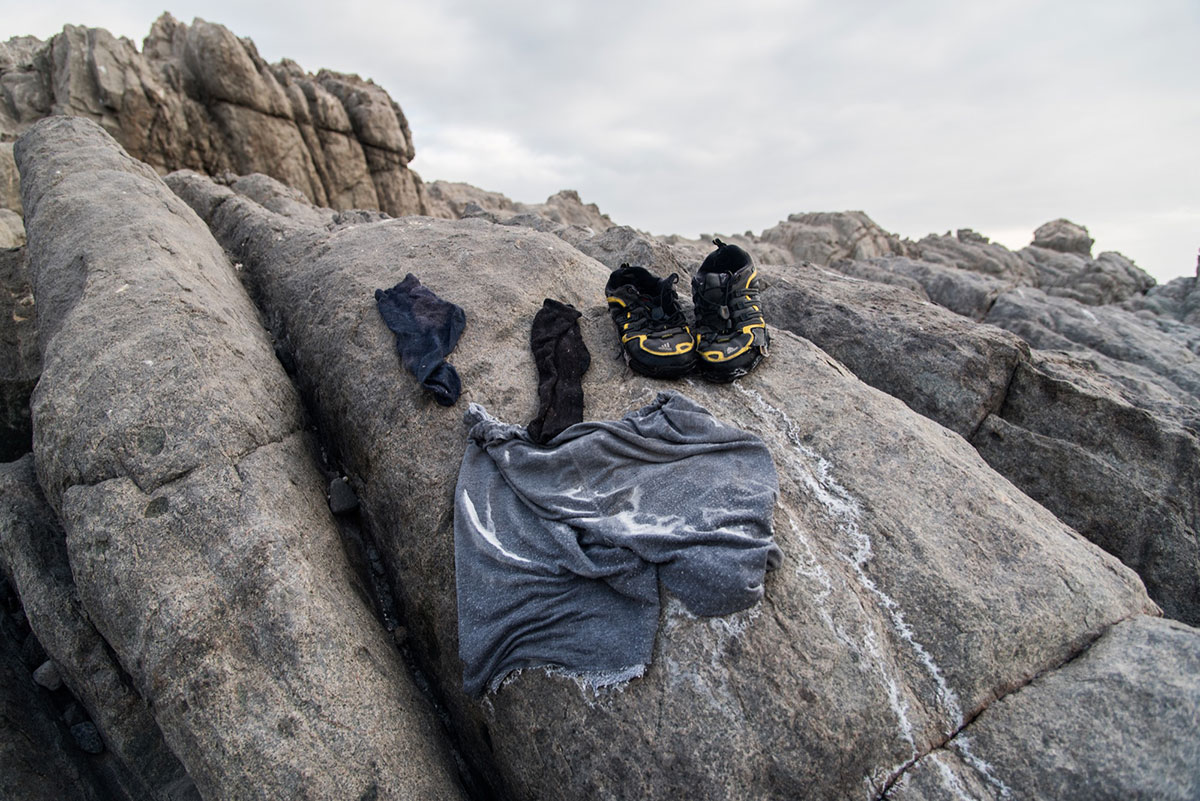
Antonio Gonzales takes off his wet clothes and leaves them to dry on the rocks. 'It's going to dry and we can use it tomorrow. Here, we use everything until the last piece,' Antonio's work partner Eric explains laughing. Then all the men jump into their rusty pickup truck, wave through the window and disappear into the rocky landscape. [Berta Tilmantaite/Al Jazeera]
Please Do Not Use
Sea lions in the sea around the rocky island. There are penguins at one end of the island, where they take care of their eggs. [Berta Tilmantaite/Al Jazeera]
Advertisement
Please Do Not Use
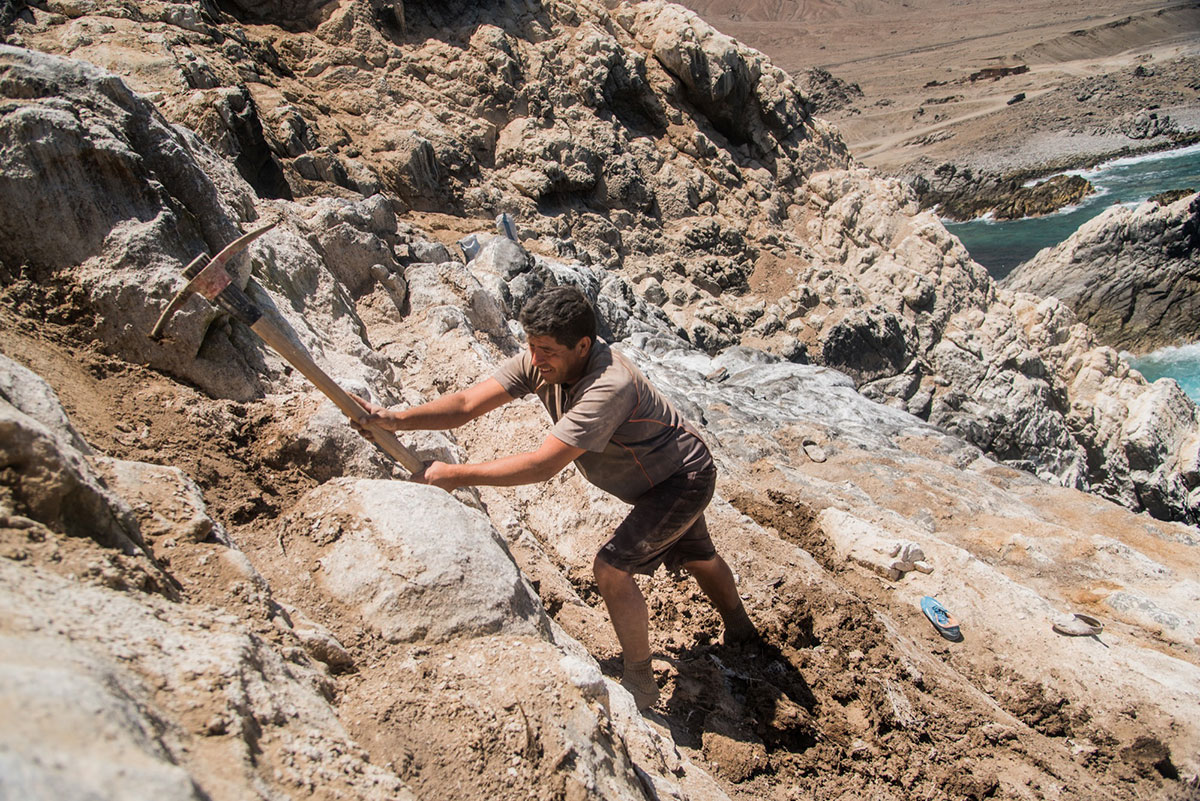
Juan Carlos Galvez ties himself to a rock with rope as he collects guano from its steep edges. Seabird guano contains nitrogen-rich ammonium oxalate and urate, phosphates, as well as some earth salts. [Berta Tilmantaite/Al Jazeera]
Please Do Not Use
Antonio Gonzales drags the rope, connected to the inflated inner tube of a tyre, that the men use to cross from the mainland to the island. He jumps into the freezing water to wash away the guano dust he is covered in. [Berta Tilmantaite/Al Jazeera]
Please Do Not Use
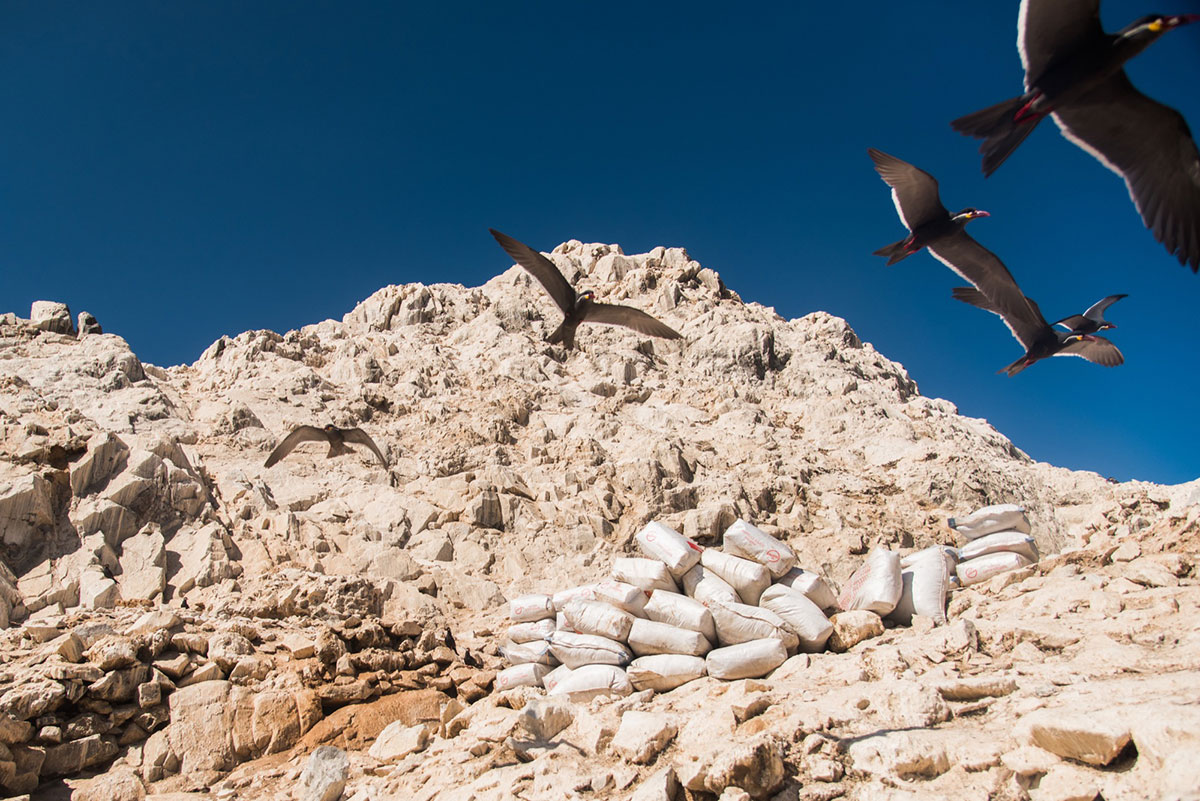
Bags full of guano are collected on an island that is home to many species of seabirds, including penguins. Collecting guano is illegal because it disrupts the habitat of these seabirds. [Berta Tilmantaite/Al Jazeera]
Please Do Not Use
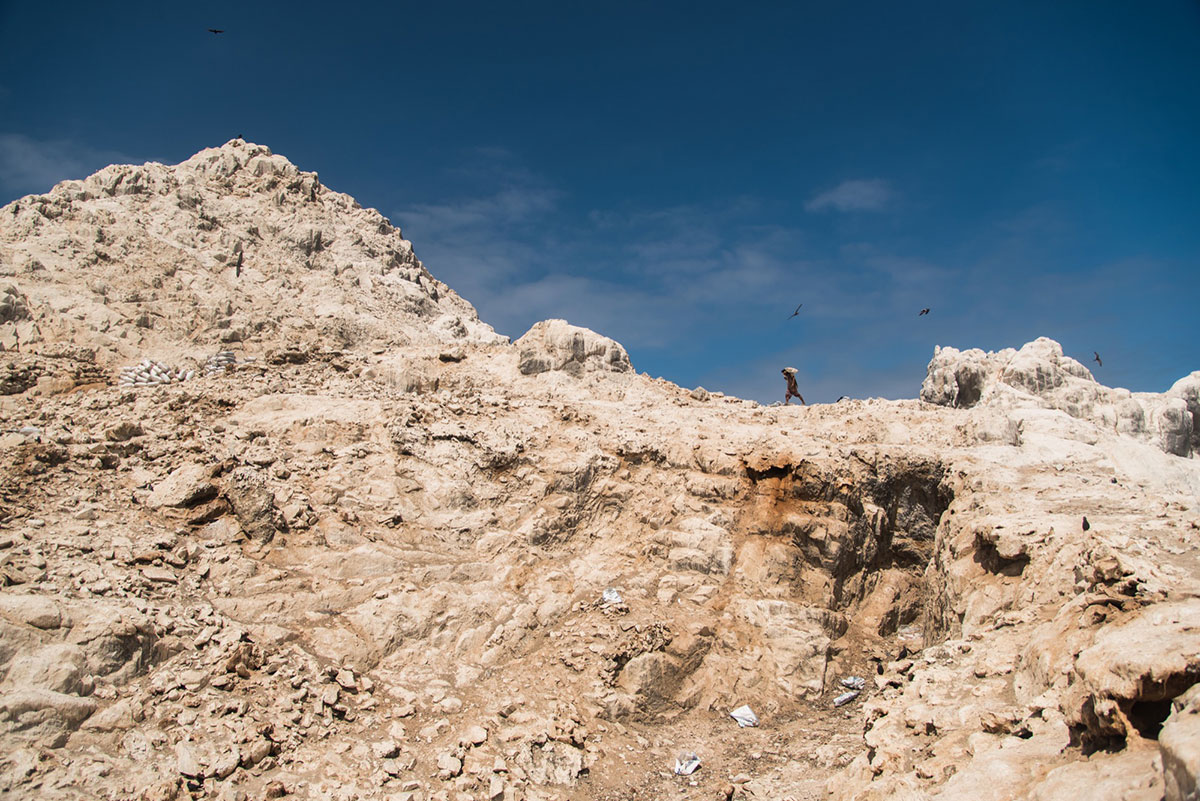
Antonio Gonzales and Manuel Rodriguez carry bags full of guano. [Berta Tilmantaite/Al Jazeera]
Please Do Not Use
Eric and Juan Carlos Galvez chat during a short break from their work. Archaeological evidence suggests the Andean people have collected guano for use as a soil amendment for over 1,500 years. There has even been a war fought over guano - The Guano War of 1865-1866, which is also known as the Peruvian-Spanish War or the Chincha Islands War. [Berta Tilmantaite/Al Jazeera]
Please Do Not Use
Eric carries a bag full of guano. Temperatures can reach 40 degrees Celcius during the middle of the day, which makes the job harder. The dust from the guano covers the collectors' bodies, leaving them itchy and uncomfortable. [Berta Tilmantaite/Al Jazeera]
Please Do Not Use
Juan Carlos Galvez and Antonio Gonzales collect guano. The men scratch the surface of the island, then gather the guano into bags which they carry to a collection point, from which they will later move them to the mainland and then on to the city for selling. [Berta Tilmantaite/Al Jazeera]
Please Do Not Use
Juan Carlos Galvez scrapes the guano with a pick. [Berta Tilmantaite/Al Jazeera]

Related

  • Into the green land: Emerald mining in Colombia

    Emerald seekers scour Colombia’s Muzo Valley, searching for the gem that could lift them out of poverty.

    Published On 20 Mar 201720 Mar 2017
    Into the Green Land/ Please Do Not Use
    This gallery article has 14 imagescamera14
  • Maintaining traditions in Salasaca of Ecuador’s Andes

    Here, men and women wear traditional clothes, hold festive rituals, and make handicrafts.

    Published On 18 Feb 201718 Feb 2017
    On Women’s Shoulders/ Please Do Not Use
    This gallery article has 14 imagescamera14

More from Gallery

  • Survivors recall terror of landslides from North Sumatra cyclone

    Many survivors are looking for their missing loved ones. Some were carried away by floodwaters, others buried under the mud.
    This gallery article has 14 imagescamera14
  • Photos: Gaza university resumes in-person classes

    Gaza University
    This gallery article has 7 imagescamera7
  • Photos: Pope prays at site of 2020 Beirut port explosion

    Pope Leo XIV visit to Lebanon
    This gallery article has 7 imagescamera7
  • Photos: Recovery under way after floods in Indonesia, Sri Lanka, Thailand

    Rescuers move people to safety on a small boat in a flooded area.
    This gallery article has 8 imagescamera8

Most popular

  • Infantino’s ‘Peace Prize’ to Trump raises questions about FIFA’s neutrality

    Trump and Infantino
  • ‘Uninterrupted oil shipments’: Key takeaways from Putin-Modi talks in Delhi

    Russia's President Vladimir Putin and India's Prime Minister Narendra Modi are seen after their talks at Hyderabad House in New Delhi on December 5, 2025 [Alexander Kazakov/Sputnik/Pool via AFP]
  • Arab, Muslim nations reject Israel exit-only plan for Gaza’s Rafah crossing

    Rafah crossing, Gaza
  • FIFA World Cup 2026 draw – updates

    A picture shows groups A, B, C, D, E, F, G, H, I, J, K and L during the draw for the 2026 FIFA Football World Cup taking place in the US, Canada and Mexico, at the Kennedy Center, in Washington, DC, on December 5, 2025. (Photo by Mandel NGAN / POOL / AFP)

  • About

    • About Us
    • Code of Ethics
    • Terms and Conditions
    • EU/EEA Regulatory Notice
    • Privacy Policy
    • Cookie Policy
    • Cookie Preferences
    • Accessibility Statement
    • Sitemap
    • Work for us
  • Connect

    • Contact Us
    • User Accounts Help
    • Advertise with us
    • Stay Connected
    • Newsletters
    • Channel Finder
    • TV Schedule
    • Podcasts
    • Submit a Tip
    • Paid Partner Content
  • Our Channels

    • Al Jazeera Arabic
    • Al Jazeera English
    • Al Jazeera Investigative Unit
    • Al Jazeera Mubasher
    • Al Jazeera Documentary
    • Al Jazeera Balkans
    • AJ+
  • Our Network

    • Al Jazeera Centre for Studies
    • Al Jazeera Media Institute
    • Learn Arabic
    • Al Jazeera Centre for Public Liberties & Human Rights
    • Al Jazeera Forum
    • Al Jazeera Hotel Partners

Follow Al Jazeera English:

  • facebook
  • twitter
  • youtube
  • instagram-colored-outline
  • rss
Al Jazeera Media Network logo
© 2025 Al Jazeera Media Network