Skip linksSkip to Content
Climate change is drying the lifeblood of navajo ranchers - Latest News & Updates
Live
Navigation menu
  • News
    • Africa
    • Asia
    • US & Canada
    • Latin America
    • Europe
    • Asia Pacific
  • Middle East
  • Explained
  • Opinion
  • Sport
  • Video
    • Features
    • Economy
    • Human Rights
    • Climate Crisis
    • Investigations
    • Interactives
    • In Pictures
    • Science & Technology
    • Podcasts
    • Travel
play
Live

In Pictures

Gallery|Climate Crisis

In Pictures: Navajo Nation’s water-scarce life

Decades of severe drought is drying the lifeblood of Navajo ranchers as their lands become desert.

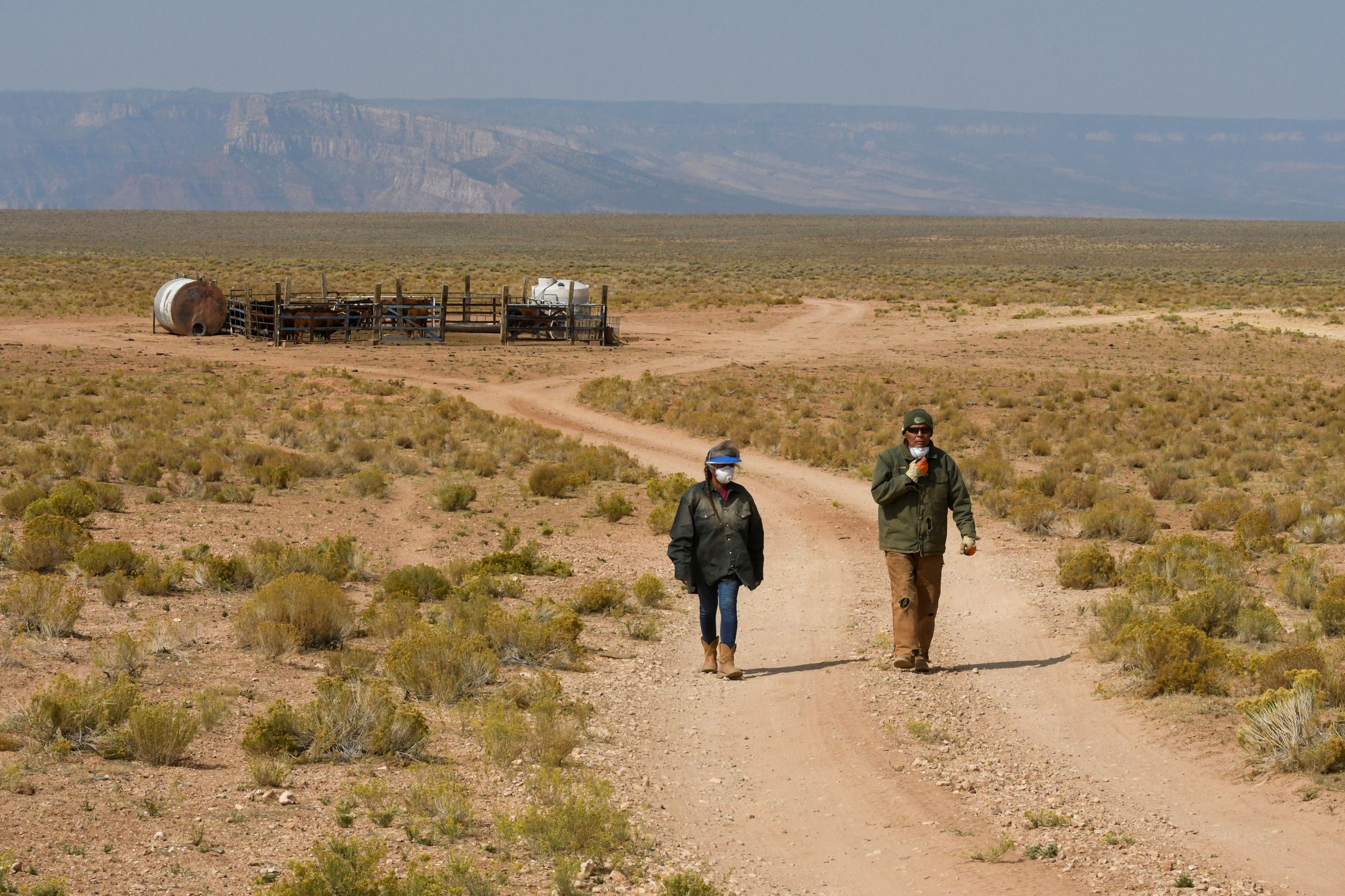
Maybelle Sloan, 59, and her husband, Leonard Sloan, 64, both from Navajo Nation, give water to their cattle, in the Bodaway Chapter in the Navajo Nation in Gap, Arizona. [Stephanie Keith/Reuters]

By Reuters

Published On 6 Oct 20206 Oct 2020

Share

facebooktwitterwhatsappcopylink

Save

Two decades into a severe drought on the Navajo reservation, the open range around Maybelle Sloan’s sheep farm stretches out in a brown expanse of earth and sagebrush.

A dry wind blows dust across the high-desert plateau, smoke from wildfires in Arizona and California shrouding the nearby rim of the Grand Canyon.

The summer monsoon rains have failed again and the stock ponds – meant to collect rainwater for the hot summer months – are dry.

With no groundwater for her animals, Sloan, 59, fills a drinking trough for them with water from a 1,200-gallon (5,400 litre) white plastic tank.

She and her husband, Leonard, have to pay up to $300 to have the tank filled as her pick-up truck has broken down.

When it works, she hauls the water herself every two days, spending $80 a week on fuel.

The Navajo Nation, which covers nearly 70,000 square kilometres (27,000 square miles) straddling the US states of Arizona, New Mexico and Utah, competes with growing cities like Phoenix for its water supply.

As climate change dries out the US West, even that supply is becoming increasingly precarious.

Maybelle Sloan and her husband spend between $3,000 and $4,000 a year on hay to supplement their animals’ feed now that the open range doesn't produce enough grass to sustain them. [Stephanie Keith/Reuters]
Advertisement
Water is becoming increasingly precarious as climate change dries out the US West. [Stephanie Keith/Reuters]
Sarah Begay, 85, walks on her family compound in a remote part of the Bodaway Chapter. The Navajo traditionally live in compounds with dwellings for extended family members on them. [Stephanie Keith/Reuters]
This year's June to August period was the driest on record in the area. [Stephanie Keith/Reuters]
Mary Secody sits inside her home in the Bodaway Chapter. Secody has electricity and running water now but says she lived without it for most of her life. It was only in the 1990s, she said, that she got both running water and electricity in her home. [Stephanie Keith/Reuters]
Previoulsy, "We got rain every year around June, July and August," according to Leonard Sloan. [Stephanie Keith/Reuters]
Advertisement
Summer Weeks, 23, bathes her daughter, in a tub outside their home in the Bodaway Chapter. The family lives in a house with no running water or electricity on a family compound "I don't mind living without running water and electricity. I grew up this way so I'm used to it. I came here because I wanted my kids to have the same kind of upbringing that I had," said Summer. [Stephanie Keith/Reuters]
Joshua Manuelito waters his garden at his home in the Bodaway Chapter. [Stephanie Keith/Reuters]
On paper, the Navajo Nation has extensive water rights but in practice, the Navajos and other tribes were left out of many 20th-century negotiations divvying up the West’s water. [Stephanie Keith/Reuters]
Eugene Boonie, 55, fills up his water tank at the livestock water spigot in the Bodaway Chapter. "We have to come here to get our water every other day. Pretty much everyone in this area gets their water here. We used to be able to collect rainwater but it just has not been raining this summer or even for the past couple of years," said Boonie. [Stephanie Keith/Reuters]
Some young people help their grandparents haul water every day from the sole well for livestock in the Bodaway-Gap area. [Stephanie Keith/Reuters]
Drought conditions on the reservation have become largely relentless since the mid-1990s. [Stephanie Keith/Reuters]
The Glen Canyon Dam, situated just north of the Navajo Nation, which creates Lake Powell from the Colorado River. All but one of the reservation’s rivers have stopped running year-round, said Margaret Redsteer, a scientist at the University of Washington in Bothell. [Stephanie Keith/Reuters]

Related

  • US wildfires: How climate change is spurring deadly blazes

    Increasingly dry conditions in arid western US states are making wildfires bigger and tougher to contain, expert says.

    Published On 11 Sep 202011 Sep 2020
    Wildfires California
  • Trump’s EPA chief: Climate change efforts hurt the poor

    EPA Administrator Andrew Wheeler said the agency will push deregulation as a priority in Trump’s possible second term.

    Published On 3 Sep 20203 Sep 2020
    EPA Wheeler
  • OPINIONOPINION,

    The coronavirus outbreak is part of the climate change crisis

    Therefore, climate action should be central to our response to the COVID-19 pandemic.

    Opinion by Vijay KolinjivadiVijay Kolinjivadi
    Published On 30 Mar 202030 Mar 2020
    Logging
    quotes

More from Gallery

  • Survivors recall terror of landslides from North Sumatra cyclone

    Many survivors are looking for their missing loved ones. Some were carried away by floodwaters, others buried under the mud.
    This gallery article has 14 imagescamera14
  • Photos: Gaza university resumes in-person classes

    Gaza University
    This gallery article has 7 imagescamera7
  • Photos: Pope prays at site of 2020 Beirut port explosion

    Pope Leo XIV visit to Lebanon
    This gallery article has 7 imagescamera7
  • Photos: Recovery under way after floods in Indonesia, Sri Lanka, Thailand

    Rescuers move people to safety on a small boat in a flooded area.
    This gallery article has 8 imagescamera8

Most popular

  • Infantino’s ‘Peace Prize’ to Trump raises questions about FIFA’s neutrality

    Trump and Infantino
  • ‘Uninterrupted oil shipments’: Key takeaways from Putin-Modi talks in Delhi

    Russia's President Vladimir Putin and India's Prime Minister Narendra Modi are seen after their talks at Hyderabad House in New Delhi on December 5, 2025 [Alexander Kazakov/Sputnik/Pool via AFP]
  • FIFA World Cup 2026 draw – updates

    A picture shows groups A, B, C, D, E, F, G, H, I, J, K and L during the draw for the 2026 FIFA Football World Cup taking place in the US, Canada and Mexico, at the Kennedy Center, in Washington, DC, on December 5, 2025. (Photo by Mandel NGAN / POOL / AFP)
  • Arab, Muslim nations reject Israel exit-only plan for Gaza’s Rafah crossing

    Rafah crossing, Gaza

  • About

    • About Us
    • Code of Ethics
    • Terms and Conditions
    • EU/EEA Regulatory Notice
    • Privacy Policy
    • Cookie Policy
    • Cookie Preferences
    • Accessibility Statement
    • Sitemap
    • Work for us
  • Connect

    • Contact Us
    • User Accounts Help
    • Advertise with us
    • Stay Connected
    • Newsletters
    • Channel Finder
    • TV Schedule
    • Podcasts
    • Submit a Tip
    • Paid Partner Content
  • Our Channels

    • Al Jazeera Arabic
    • Al Jazeera English
    • Al Jazeera Investigative Unit
    • Al Jazeera Mubasher
    • Al Jazeera Documentary
    • Al Jazeera Balkans
    • AJ+
  • Our Network

    • Al Jazeera Centre for Studies
    • Al Jazeera Media Institute
    • Learn Arabic
    • Al Jazeera Centre for Public Liberties & Human Rights
    • Al Jazeera Forum
    • Al Jazeera Hotel Partners

Follow Al Jazeera English:

  • facebook
  • twitter
  • youtube
  • instagram-colored-outline
  • rss
Al Jazeera Media Network logo
© 2025 Al Jazeera Media Network