Skip linksSkip to Content
Photos near ukraines front lines women endure the war alone - Latest News & Updates
Live
Navigation menu
  • News
    • Africa
    • Asia
    • US & Canada
    • Latin America
    • Europe
    • Asia Pacific
  • Middle East
  • Explained
  • Opinion
  • Sport
  • Video
    • Features
    • Economy
    • Human Rights
    • Climate Crisis
    • Investigations
    • Interactives
    • In Pictures
    • Science & Technology
    • Podcasts
    • Travel
play
Live
Navigation menu
  • Russia-Ukraine war
  • What is in the 28-point US plan for Ukraine?
  • 'Ukraine is running out of men, money and time'
  • Can the US get all sides to end the war?
  • Why is Europe opposing Trump’s peace plan?

In Pictures

Gallery|Russia-Ukraine war

Photos: On Ukraine’s front lines, women endure the war alone

In eastern Ukraine, 1.6 million of the 2.9 million people in need are women, the UN says.
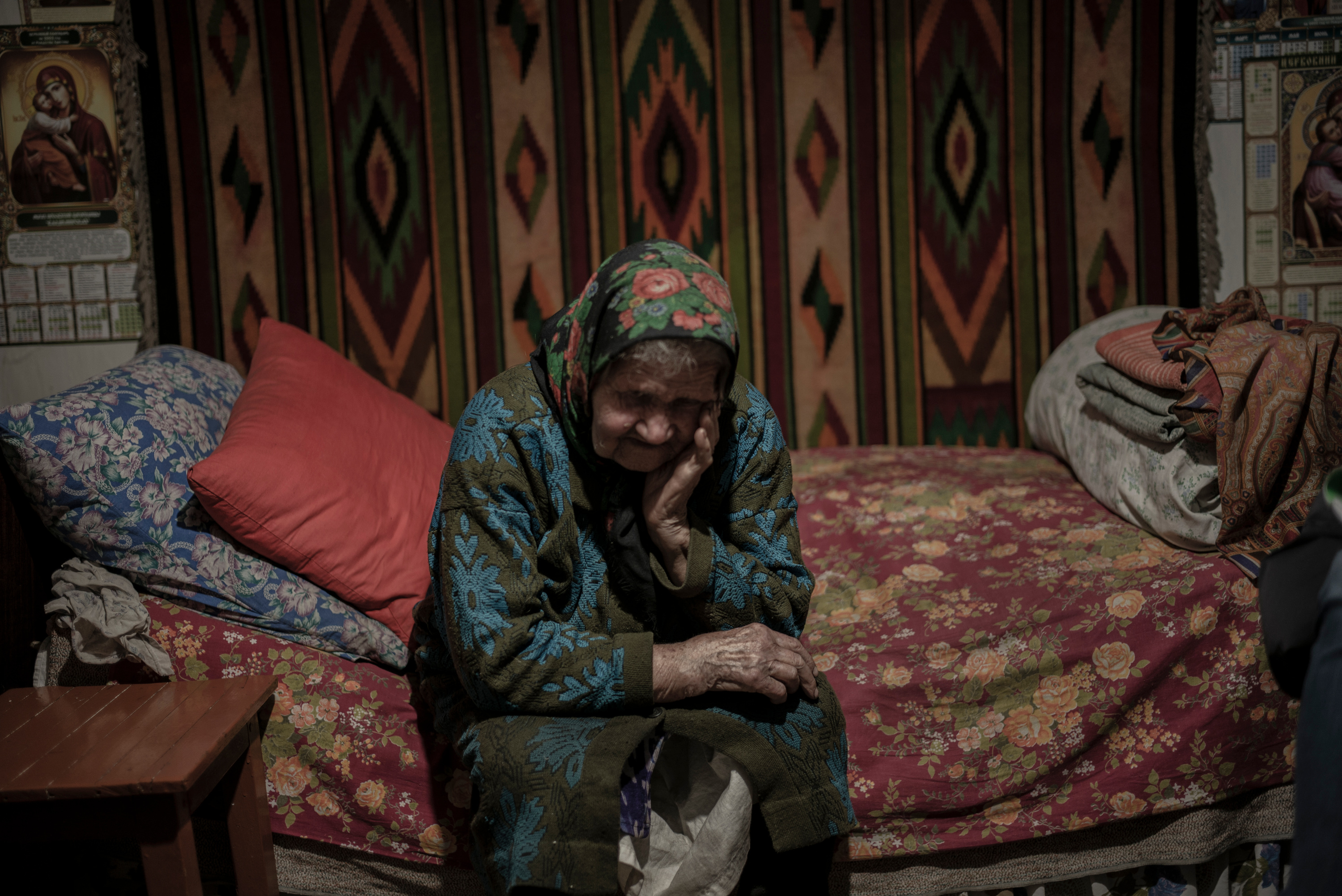
Vera, 94, lives on the front line in Marinka, a town separated by the front line in the suburbs of Donetsk.
Vera, 94, lives on the front line in Marinka, a town in eastern Ukraine separated by the front line in the suburbs of Donetsk. After being targeted by shells in 2015, she became very pious. Shortly after this photo was taken, Vera was found paralysed in her bed by a social worker of the NGO People In Need and has been in the hospital since. [Guillaume Binet/MYOP/Al Jazeera]

By Sara Cincurova and Guillaume Binet

Published On 6 Feb 20226 Feb 2022

Share

facebooktwitterwhatsappcopylink

Save

In the midst of a war between Ukrainian forces and Russian-backed eastern separatists that has killed an estimated 14,000 people since 2014, many vulnerable or elderly women have lost their husbands to fighting and health problems and survive near the front lines alone.

“My husband died of a heart attack and my only son has disappeared. In my family, I am now the only woman left,” said Ala Nikolaevna, 73, a blind woman living in the Ukrainian town of Chasiv Yar, a few kilometres from the front line.

She cries as she recalls the last time she had hugged her son Oleg, who disappeared shortly after he had joined a paramilitary group in 2014.

Nikolaevna, who is blind due to diabetes, now lives alone in her three-bedroom flat. Her diabetes symptoms are worsening and her overall health is deteriorating as the heating does not always work in the war zone and she does not have regular access to drinking water either.

“When there is no heating, I put all my clothes on and pray. I have only one wish: that my son hugs me once again,” she says.

Alyona, 41, a social worker and volunteer, brings Nikolaevna food three times a week.

“Out of the 12 people that I work with, 10 are women,” Alyona, who did not want to disclose her last name due to the sensitive nature of her work, told Al Jazeera.

“Since the war started, all the men joined the military or looked for work in other regions of Ukraine, and there are now mostly women living on the front line alone.”

According to the United Nations Office for the Coordination of Humanitarian Affairs (OHCA) (pdf), 1.6 million of the 2.9 million people in need of humanitarian assistance in eastern Ukraine are women.

Advertisement

“In this region, the only job a man can do is to become a miner; therefore, many men suffer severe health consequences and die young,” Alyona added.

“The front line villages are full of single mothers and babushkas (grandmothers).”

Lizaveta Zhuk, a public information officer for OCHA Ukraine, told Al Jazeera that: “In the government-controlled areas of Ukraine, 71 percent of heads of households are female. This share is even higher for those who are more than 60 years old, and reaches 88 percent”.

Jan Egeland,  secretary-general of the Norwegian Refugee Council NGO working on the front line, told Al Jazeera that the older, predominantly female population in eastern Ukraine is very different to most other wars where the NGO is active.

“You cannot have a war in a place filled to the brim with old, freezing or vulnerable people, who are struggling to survive after eight years of conflict,” he said.

Evdokia Ivanovna, 84, looks at her family archives in a photo album that has Lenin's portrait on the cover.
Evdokia Ivanovna, 84, looks at photos of her family in an album with Lenin's portrait on the cover. As she recalls the 54 years she has spent in her house in the front line village of Zolote, shooting from automatic weapons can be heard in the background. "All the men in my family died because they had worked in the mines and suffered the health consequences of that," she says. "I am alone and hear shooting all the time, but I am already used to it." [Guillaume Binet/MYOP/Al Jazeera]
Advertisement
Ivanovna's family album shows her in a uniform (on the right), along with her colleagues as they prepare for a shift in a local mine, during the Communist era
Ivanovna's family album shows her in a uniform, right, with colleagues as they prepare for a shift in a local mine during the Soviet era. "My job was to help male miners, providing them with lighting in the mines. I did that for 26 years," Ivanovna recalls. [Guillaume Binet/MYOP/Al Jazeera]
Natasha, 35, is mother to 7 children, the youngest of whom is only 1 year old.
Natasha, 35, is the mother of seven children, the youngest of whom is only one year old. "When the war started, we all lived in our basement," she says. "But it was always my dream to have a big family." Their village, Krasnohorivka, is situated just several hundred meters from the front line. "The biggest problem is the cold. We do not have enough wood to warm our house and my children are often cold," Natasha told Al Jazeera. [Guillaume Binet/MYOP/Al Jazeera]
In Adviivka, Olga lives alone in an apartment that was shelled three times.
In Adviivka, Olga lives alone in an apartment that has been shelled three times. She does not hide her pro-European views and says she still has not recovered from seeing her house "wounded". "I naively thought that nothing bad could happen to me in this apartment," she said. Her daughter, a professor at the University of Odessa, came to visit. [Guillaume Binet/MYOP/Al Jazeera]
Maria, 56 (on the right), joins her Protestant church every Sunday in the front line village of Marinka
Maria, 56, right, attends her Protestant church in the front-line village of Marinka every Sunday to sing and pray. "I know that there are sad, unfortunate people who are depressed and live in the dark of the war. But my life is a happy one: I believe in God, and my life is full of love and joy, even on the front line," she says. [Guillaume Binet/MYOP/Al Jazeera]
Krystyna, 16, wants to become a beauty salon owner.
Krystyna, 16, wants to own a beauty salon. She lives in the front-line village of Slavne, surrounded by minefields. She regularly hears explosions on her way to school, but still dreams of a better future and hopes she can build a successful career in the world of beauty. [Guillaume Binet/MYOP/Al Jazeera]
Advertisement
Lydia, 85, opens the door of her dilapidated house surrounded by soldiers and landmines.
Lydia, 85, opens the door of her dilapidated house surrounded by soldiers and landmines. "I have lived in this house my entire life and I do not want to leave. I have lived here alone for 60 years, ever since my husband died. I hear shelling every night, but I want to die in my own bed." [Guillaume Binet/MYOP/Al Jazeera]
Svetlana, a mother of three, decided to adopt 5 children, and turned her house into a children's home.
Svetlana, a mother of three, decided to adopt five children and turned her house into a children's home. Right before she prepares lunch for her family, Svetlana sits in her kitchen with her two sons aged 16 and five, while the other children are in school. "It was my dream to adopt many children," she said. Although the family lives in Zolote, only 3km (2 miles) from the front line, Svetlana hopes for a better future. "In 2014, we were all living in our basement. In recent years, the situation has become calmer, but I still have a little suitcase with all my children's documents ready, in case we need to flee." [Guillaume Binet/MYOP/Al Jazeera]
Ala Nikolaevna, 73, a Blind diabetes patient in her home in Chasiv Yar
Ala Nikolaevna, 73, a blind sufferer from diabetes sits in her home in Chasiv Yar. She is mourning the death of her husband and the disappearance of her only son from whom she has not heard since 2014. She struggles to survive on her own. "I am blind and cannot go out any more, not even to do my shopping," she says. "But I always have honey in my house, and I can put it in my mouth whenever I feel like I am about to pass out." [Guillaume Binet/MYOP/Al Jazeera]
The frontline village of Opytne, only 800 meters away from the front line.
The front-line village of Opytne is only 800m (875 yards) from the front line. Not a single house remains intact, and the women who live there alone rely on the help of NGOs to help rebuild their destroyed roofs and windows. [Guillaume Binet/MYOP/Al Jazeera]
Katia, 76, does not want to leave her house in Nevelske.
Katia, 76, does not want to leave her house in Nevelske. The village, nearly destroyed by the war, is now left without electricity, gas and water. When humanitarian workers from the International Committee of the Red Cross came to support Katia and her husband, she said: "Nevelske is worse than in prison, because in prison at least you are fed. I would give anything for this to stop." [Guillaume Binet/MYOP/Al Jazeera]
Svetlana, 46, had to leave her house in the village of Nevelske after recent shellings in December 2021 destroyed two neighboring houses and heavily damaged her own.
Svetlana, 46, had to leave her house in the village of Nevelske after recent shelling in December 2021 destroyed two neighbouring houses and heavily damaged her own. She found refuge in the village of Pervomais'ke, a few kilometres away, and was able to save two cows. A farmer before the war, her only income today is the production of fresh cow cheese. "Women run the homes," she says, "they are often more courageous and resilient than men." [Guillaume Binet/MYOP/Al Jazeera]
Nevelske is a destroyed village on the Ukrainian front line near Donetsk.
Nevelske is a destroyed village on the Ukrainian front line near Donetsk. Partially rebuilt after a separatist offensive in 2015, the village was heavily shelled again in December 2021. A few people still survive there, without water, gas or electricity. [Guillaume Binet/MYOP/Al Jazeera]

Related

  • War-weary residents lament homes lost in eastern Ukraine shelling

    Destruction of homes in a small village near frontlines in Donbas raises fears of a worsening humanitarian crisis.

    Published On 30 Jan 202230 Jan 2022
    An abandoned house in Nevelske village. Ukraine
  • On Ukraine’s front line, Britons battle Russia-backed separatists

    A handful of British soldiers fighting against Russia-backed separatists say they are motivated by a sense of duty.

    Published On 1 Feb 20221 Feb 2022
    Aiden, a British soldier in Ukraine
  • Sanctions: A powerful weapon in Ukraine standoff?

    Western capitals threaten Russia with sanctions if it invades Ukraine.

    Published On 5 Feb 20225 Feb 2022
    Video Duration play-arrow
  • Ukraine crisis: Who are the Russia-backed separatists?

    About 4 million live in two pro-Russia statelets, including fighters who were born in Ukraine and Russian volunteers.

    Published On 4 Feb 20224 Feb 2022
    Pedestrians walk in central Donetsk, eastern Ukraine, the capital of a self-proclaimed Donetsk People's Republic (DPR), on January 19, 2022. - A poster on the left reads: "We Are the Russian Donbass!". (Photo by Alexander NEMENOV / AFP)

More from Gallery

  • Survivors recall terror of landslides from North Sumatra cyclone

    Many survivors are looking for their missing loved ones. Some were carried away by floodwaters, others buried under the mud.
    This gallery article has 14 imagescamera14
  • Photos: Gaza university resumes in-person classes

    Gaza University
    This gallery article has 7 imagescamera7
  • Photos: Pope prays at site of 2020 Beirut port explosion

    Pope Leo XIV visit to Lebanon
    This gallery article has 7 imagescamera7
  • Photos: Recovery under way after floods in Indonesia, Sri Lanka, Thailand

    Rescuers move people to safety on a small boat in a flooded area.
    This gallery article has 8 imagescamera8

Most popular

  • ‘Uninterrupted oil shipments’: Key takeaways from Putin-Modi talks in Delhi

    Russia's President Vladimir Putin and India's Prime Minister Narendra Modi are seen after their talks at Hyderabad House in New Delhi on December 5, 2025 [Alexander Kazakov/Sputnik/Pool via AFP]
  • Infantino’s ‘Peace Prize’ to Trump raises questions about FIFA’s neutrality

    Trump and Infantino
  • FIFA World Cup 2026 draw – updates

    A picture shows groups A, B, C, D, E, F, G, H, I, J, K and L during the draw for the 2026 FIFA Football World Cup taking place in the US, Canada and Mexico, at the Kennedy Center, in Washington, DC, on December 5, 2025. (Photo by Mandel NGAN / POOL / AFP)
  • Pakistan seeks new South Asian bloc to cut India out: Will it work?

    Mohammad Touhid Hossain, foreign affairs adviser of Bangladesh's interim government and Ishaq Dar, Pakistan's foreign minister, attend a bilateral meeting in Dhaka, Bangladesh [File: Bangladesh's Ministry of Foreign Affairs/Handout via Reuters]

  • About

    • About Us
    • Code of Ethics
    • Terms and Conditions
    • EU/EEA Regulatory Notice
    • Privacy Policy
    • Cookie Policy
    • Cookie Preferences
    • Accessibility Statement
    • Sitemap
    • Work for us
  • Connect

    • Contact Us
    • User Accounts Help
    • Advertise with us
    • Stay Connected
    • Newsletters
    • Channel Finder
    • TV Schedule
    • Podcasts
    • Submit a Tip
    • Paid Partner Content
  • Our Channels

    • Al Jazeera Arabic
    • Al Jazeera English
    • Al Jazeera Investigative Unit
    • Al Jazeera Mubasher
    • Al Jazeera Documentary
    • Al Jazeera Balkans
    • AJ+
  • Our Network

    • Al Jazeera Centre for Studies
    • Al Jazeera Media Institute
    • Learn Arabic
    • Al Jazeera Centre for Public Liberties & Human Rights
    • Al Jazeera Forum
    • Al Jazeera Hotel Partners

Follow Al Jazeera English:

  • facebook
  • twitter
  • youtube
  • instagram-colored-outline
  • rss
Al Jazeera Media Network logo
© 2025 Al Jazeera Media Network